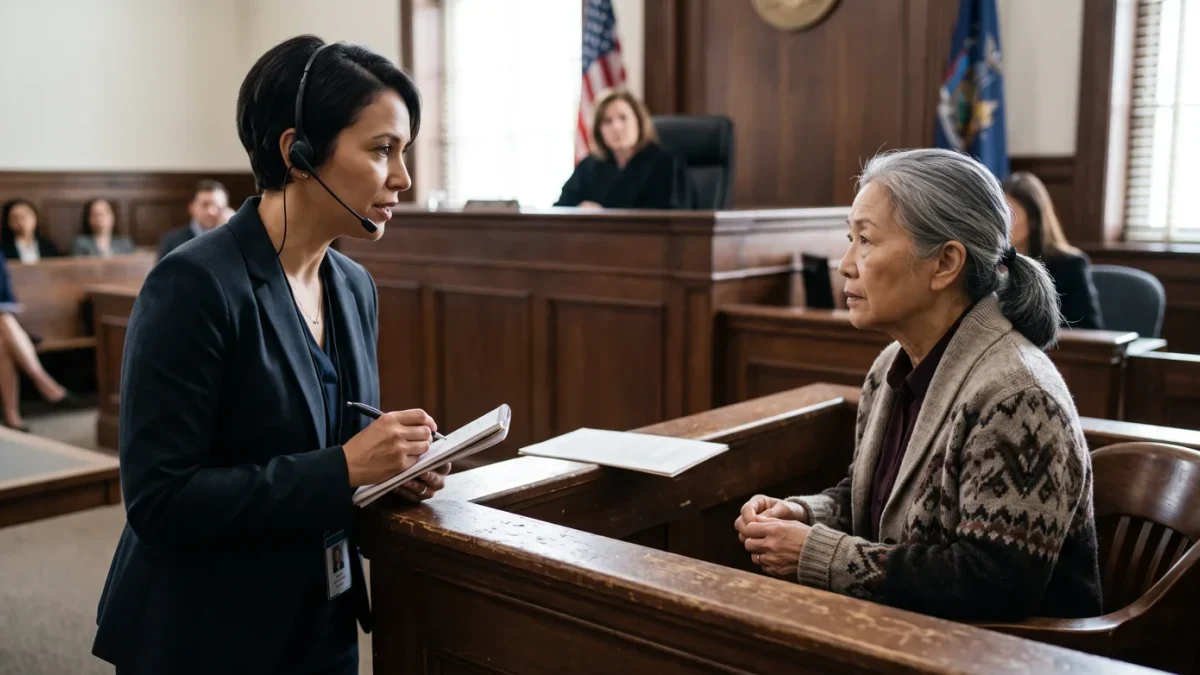
Courts that receive federal funds must provide meaningful access to people with limited English proficiency under Title VI of the Civil Rights Act of 1964 and its 2000 executive-order implementation — an obligation the Department of Justice has enforced through compliance reviews, technical-assistance letters, and findings against state court systems. The requirement covers interpreters in civil as well as criminal proceedings, translated vital documents, and notice in the languages a community actually speaks. The National Center for State Courts' language-access surveys and DOJ's own investigation files document the practice gap: interpreter shortages in rural courts, fees charged to parties in violation of the mandate, children and family members pressed into interpreting, and video-remote interpreting that fails in proceedings where precision is the point.
What is the legal basis?
Title VI's disparate-impact regulations, which prohibit recipients of federal financial assistance from denying services or providing them in a discriminatory way on the ground of national origin. Courts took the position — rejected by DOJ in formal guidance after an Alabama federal-court litigation in the late 1990s — that they were exempt as arms of the judiciary; DOJ's position, sustained by the threat and reality of funding conditions, is that the entire state court system is covered. The criminal side rests additionally on the Constitution: the Confrontation Clause and due process require a competent interpreter for defendants who cannot understand the proceedings, per the line of authority from United States ex rel. Negron (1970) onward, and the Court Interpreters Act sets a federal certification standard for Spanish and certification pathways for other languages.
Why is competency the battleground?
Because interpretation errors are due-process errors, invisible unless someone bilingual reads the record. Certification testing — federal and the consortium of states using the National Center's exams — measures simultaneous and consecutive skill and legal terminology; the certified supply is thin outside Spanish in most states, so courts schedule certified interpreters first and, per the NCSC's access studies, fill gaps with uncertified staff, telephonic services, or bilingual employees whose proficiency is unassessed. Wrong-language events — indigenous-language speakers from Latin America assumed to be Spanish-proficient — are a documented failure mode in immigration and criminal dockets, and DOJ's investigations of county systems have repeatedly ordered triage screening for exactly that.
What about documents and digital doors?
The mandate extends to notices, summons, plea forms, and protection-order paperwork designated vital — translated into the languages meeting a population-share threshold the federal guidance sets. The modern frontier is self-represented litigation: court forms filed online, e-filing portals, and remote hearings all presume a fluency the mandate never excused, and access commissions have flagged the combination — unrepresented parties plus language barriers plus digital-only processes — as the compounding problem of the current decade. Several states now maintain translated form libraries and interpreter-mapped courthouse signage; others, per the NCSC surveys, still charge parties interpreter fees that DOJ guidance says cannot be imposed as a condition of access in any proceeding.
Who checks compliance?
Complaints go to DOJ's Civil Rights Division, whose letters to state systems — from the Alabama, Kentucky, and North Carolina investigations onward — read as the operative enforcement record: findings on fees, interpreter competency, and translated signage, resolved through remedial plans rather than funding cutoffs. Inside the courts, language-access plans are the compliance instrument every federal funding stream now expects; their quality varies, and court-association audits describe plans unfunded in the years after adoption. The measurement gap is the usual one — no national dataset counts interpretation errors or access denials, so the record is built from investigations, appellate reversals where interpretation failures surfaced, and the surveys that keep finding the same gaps.
What should a person with limited English do?
Request an interpreter in advance and in writing, ask for a certified interpreter when the proceeding matters, and decline the child or relative offered as a stopgap — the codes of professional responsibility for interpreters prohibit family interpreting precisely because role conflict and vocabulary gaps corrupt the record. If fees are charged, that fact belongs in a complaint to the state's office of courts access and to DOJ. The right is statutory and, in criminal cases, constitutional; what converts it from paper to service is the ask, made early and recorded.