More than 4,000 specialty courts operate in the United States — drug courts, veterans treatment courts, mental health courts, DUI courts, and family drug courts — per the National Association of Drug Court Professionals' counts and the National Drug Court Institute's resource listings. The model reroutes defendants whose offenses are tied to addiction, mental illness, or — in the veterans dockets' specific theory — service-connected trauma, into judicially supervised treatment instead of standard prosecution. The evaluation literature, including multi-site studies and the Johnson Institute- and NIJ-funded work synthesized by the National Academies, finds drug-court participants recidivate at meaningfully lower rates than matched defendants processed conventionally, an evidence base treatment courts cite against the skepticism the model drew in its early years.
How does a treatment court actually work?
Eligibility screening, a guilty plea or stipulation in most models, then a phased program: treatment, regular drug testing, status hearings before the same judge — the model's signature, with participants appearing monthly or more often to answer for progress — and graduated sanctions for relapse or noncompliance, from essay assignments to brief jail, paired with graduated incentives. Completion means dismissal or reduced charges in the commonest pre-plea and post-plea structures; failure means prosecution or sentencing resumes on the original terms. The role changes are the point: the prosecutor and defender step back from adversarial postures into a team, and the judge becomes the supervisor — which critics on both sides, defense bar and victims' advocates, describe as the model's tension: the courtroom's coercion wrapped around clinical care.
What is different about veterans courts?
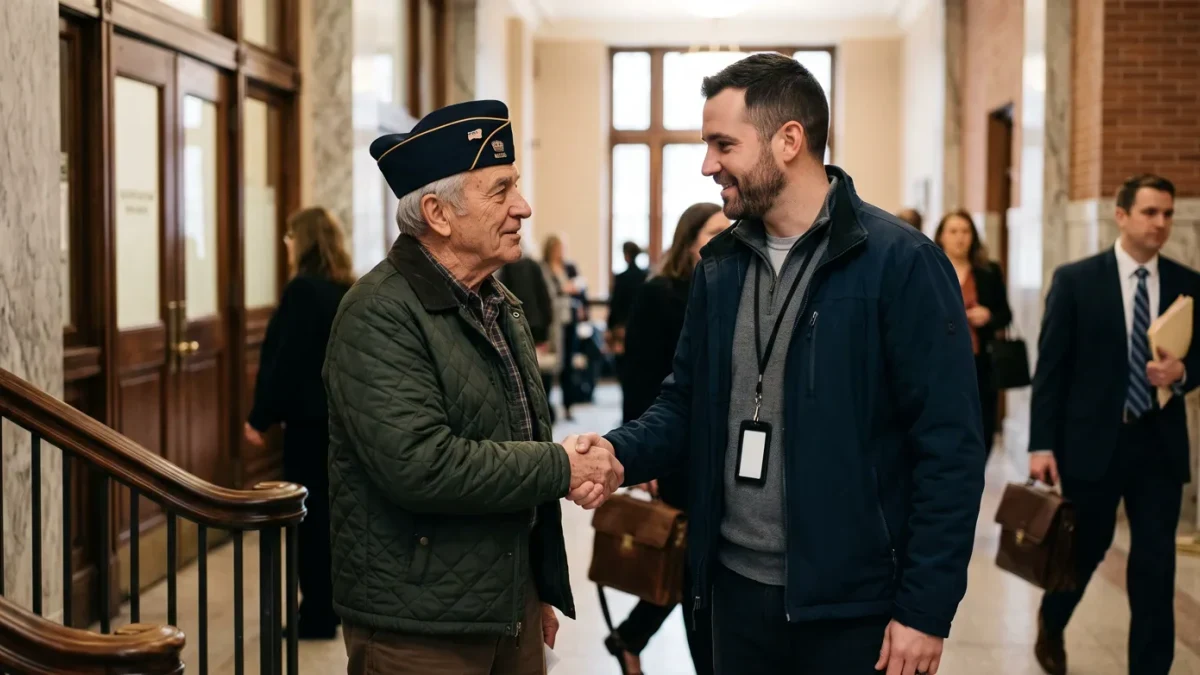
The mentor component and the VA. Veterans treatment courts, which spread from Judge Robert Russell's Buffalo court in 2008 to hundreds of dockets, pair eligible veteran-defendants with volunteer veteran mentors and route treatment through the Department of Veterans Affairs' health system — a parallel infrastructure other specialty courts lack. Eligibility requires veteran or service status and, in most dockets, charges that qualify — many exclude violent offenses, with dockets varying. Per the VA's justice-outreach program data, its specialists connect tens of thousands of justice-involved veterans annually to treatment through these dockets and jails, and the model's evaluations — smaller and younger than the drug-court literature — show retention and recidivism improvements consistent with the parent model, with the mentor relationship the component participants themselves rate highest.
What are the critiques?
Three, documented. Net-widening: courts admitting defendants who would have received diversion or dismissal anyway, so the treatment-program population grows without reducing incarceration — a finding of the early NIJ evaluations that program design has since tried to counter with eligibility rules. Selection: participants are chosen for suitability, and the success statistics exclude the refused and the terminated, which the research literature treats as the standard caveat on every program evaluation. And rights: the guilty-plea entry, the supervision conditions, and the graduated jail sanctions impose burdens conventional prosecution might not — a critique from the defense bar that treatment-court practitioners answer with the outcomes data, and the honest summary that both are true: the model works, and it works through a courtroom.
What does the system-level picture show?
Growth, with capacity limits. The veterans-justice population is documented in BJS surveys — a substantial share of people in prisons and jails report prior military service, with substance use and PTSD diagnoses elevated — and the dockets serving them exist in a fraction of jurisdictions, concentrated where federal VA facilities and interested judges coincide. Rural coverage is the visible gap; rural dockets without local VA infrastructure run on community providers, with the mentor corps thinner. Funding runs through state court systems, federal grants, and the VA's outreach budget — an assemblage that sustains existing courts but, per the associations' own policy assessments, has not extended the model to the jurisdictions without it.
What should participants and families know?
That the program is a contract with real terms: length — commonly 12 to 24 months — the testing schedule, the sanction ladder, and what completion produces in charges. The choice to enter belongs to the defendant, with counsel's advice, and the choice to terminate belongs to the team. What the evaluations support saying plainly: for the population these courts select, they outperform the alternative — and the selection is the term every participant should read.