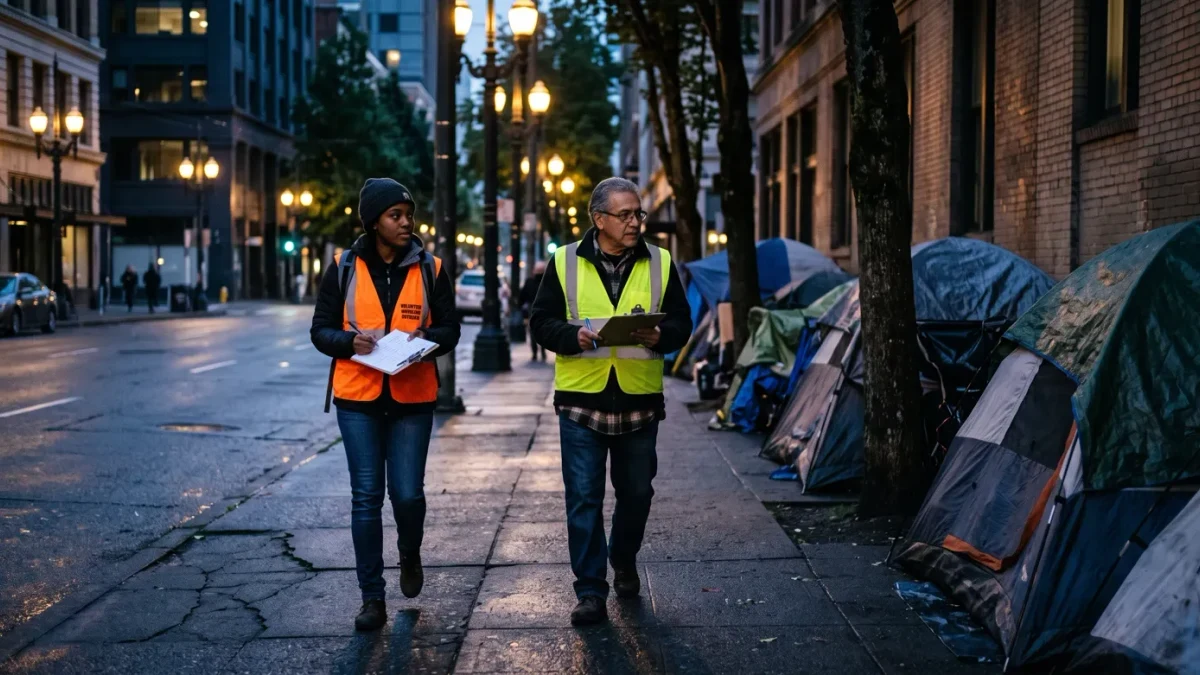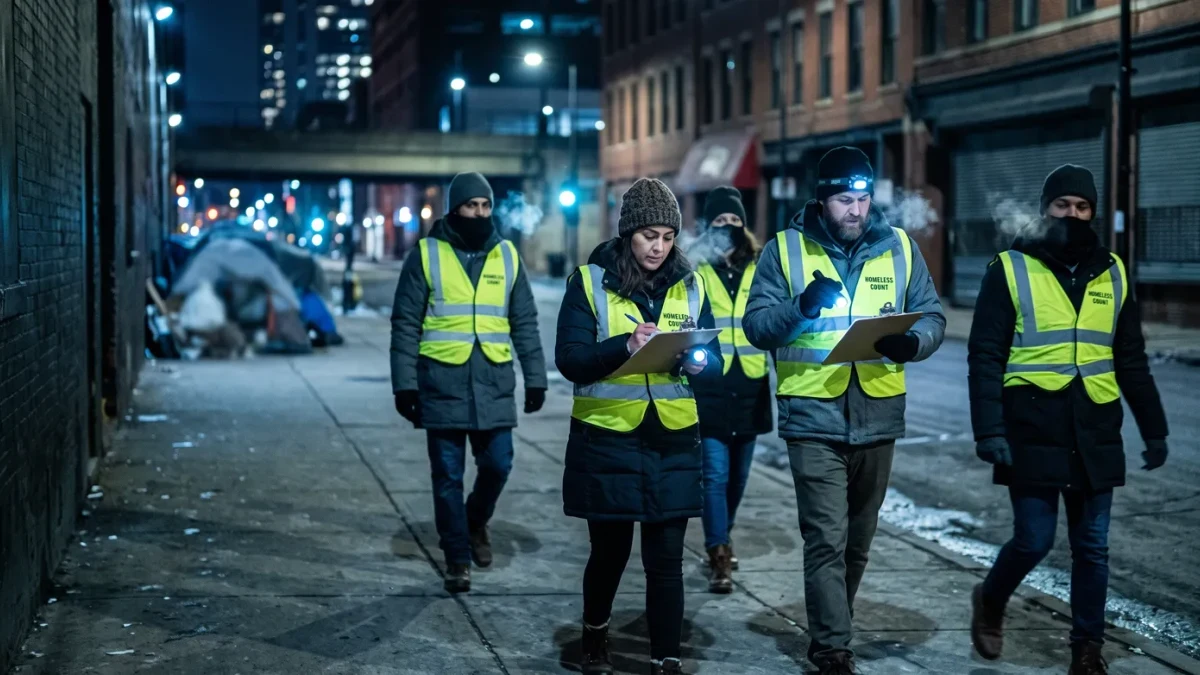
Every January, in the last ten days of the month, communities across the country send staff and volunteers to count people sleeping in shelters and on streets, in cars, and under overpasses on a single night. This point-in-time count, required by the Department of Housing and Urban Development of every continuum-of-care agency that wants federal homeless funding, produced a national estimate of roughly 771,000 people homeless on the January 2024 count night — a record, and an 18 percent single-year rise driven largely by family homelessness. The count is the denominator for over a billion dollars of federal allocation decisions, and every researcher who uses it, including HUD's own methodological reviews, agrees it undercounts.
How is the count actually done?
Two methods run in parallel. Sheltered counts are administrative: agencies report bed occupancy from HMIS, the homeless-management information system, on the count night. Unsheltered counts are physical: volunteers, often with lived experience as guides, walk or drive assigned routes logging every tent, vehicle, and person apparently sleeping outside, with tally counts in large cities and sample-based approaches in some rural areas. Communities must count at least every other year; nearly all now count annually. The one-night design is the method's core compromise: it trades completeness for comparability — a fixed instrument measuring the same thing each year — and its partisans argue the trend line, not the level, is what matters.
Why does it undercount?
Because unsheltered homelessness is, by definition, hard to see. People sleeping in places volunteers are told not to enter — private property, industrial areas, woods — go uncounted; people who circulate among friends' couches are not homeless by HUD's definition at all, though school districts, using a broader Education Department definition that includes doubled-up families, count homeless students in the millions, many times the HUD figure for families. The racial dimension compounds the technical one: Black Americans are homeless at roughly three times their population share per HUD's counts, and studies suggest undercounting is itself concentrated in over-policed communities where visibility is dangerous — which means the undercount may be racially patterned too. Cold January nights, which the count's design chose to make detection feasible, also push people into hidden locations precisely then.
What does the count drive?
HUD uses PIT totals and HMIS data to score continuums' applications for competitive funding, to set national policy baselines, and to report to Congress; local governments use the numbers to size interventions and to declare emergencies. When counts fall, programs are credited; when they rise — as in the 2023 and 2024 record national counts, driven by rents and the expiry of pandemic-era supports — the political response follows the number that exists. Communities with weak counts, an internal HUD review documented, receive weaker federal scores — the method punishing the places where counting is hardest.
What are the alternatives?
Methodologists have proposed registry weeks — by-name canvasses used in Built for Zero campaigns — administrative-data linkage that counts service touchpoints across the year, and capture-recapture statistical adjustment borrowed from wildlife surveying. Each trades the count's simplicity for coverage. A few large communities have experimented; HUD's federal reporting still runs on the January night. In 2024 and 2025, HUD's own notices acknowledged the strain, offering flexibility and methodological pilots after count participation and quality visibly suffered in some places — the same agencies managing record shelter demand being asked to mount a volunteer census.
What should readers take from the January number?
That it is a floor, and a useful one: comparable across years, honest about its method, and generous about publishing its own limitations in HUD's annual reports. The interventions the count funds — coordinated entry, permanent supportive housing, rapid rehousing — are evaluated against the same imperfect series. The people it misses are not statistical noise: they are the hidden homeless the school districts see, the families doubling up, the people in places volunteers don't walk — and for them, the count's precision matters less than the fact that the number that is counted, record-high and rising, already exceeds the housing stock every program has to offer.