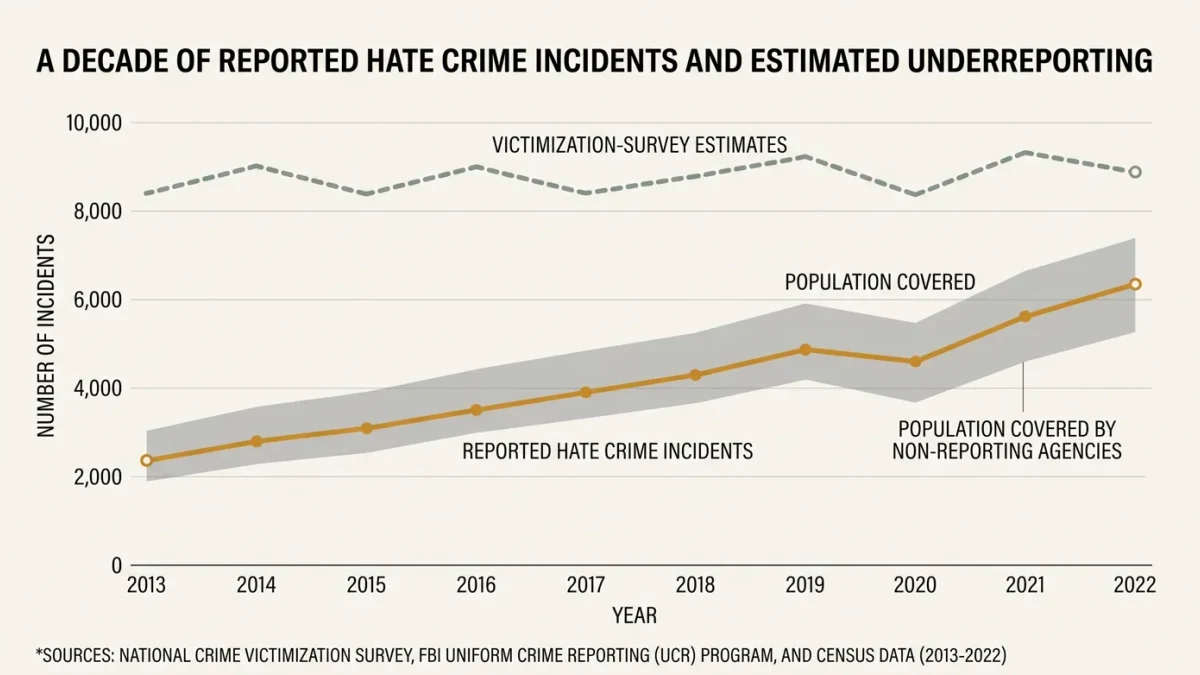
The FBI's hate crime statistics — published annually under the Hate Crime Statistics Act, with the 2024 edition released in 2025 — have shown reported incidents rising for most of a decade, with anti-Black, anti-Jewish, and anti-LGBTQ offenses leading the categories in recent years, and record totals in the reports covering 2023 and 2024. The second finding, the one researchers treat as more important: participation is voluntary, and in any given year thousands of law-enforcement agencies — including departments covering millions of residents — either report zero hate crimes or submit no data at all, a gap documented in every audit by the Brennan Center's and the Anti-Defamation League's analyses of agency-level submissions. Both facts are true at once: more hate crimes reported, and a system that cannot say how many there are.
What is a hate crime, statistically?
Two federal layers apply. The statistics act's collection counts crimes motivated by bias against race, religion, ethnicity, sexual orientation, disability, gender, and gender identity. Charging statutes exist federally — the Matthew Shepard and James Byrd Jr. Act's 2009 coverage of race-, religion-, national-origin-, gender-, sexual-orientation-, and disability-motivated violence, proven under a nexus to interstate commerce — and in 45-plus states with varying categories: several states still exclude gender identity, a few historically excluded sexual orientation, and Wyoming's and two other states' statutes remain narrow or absent. Police, not courts, assign the bias motivation for the FBI's count, based on the reporting officer's evidence of motive — evidence that is often ambiguous precisely when cases are.
Why do agencies report zero?
Mixtures of training, definitions, and incentives. Bias identification is a skill the FBI teaches in voluntary courses most officers never take; departments without dedicated reporting staff default to none; and smaller agencies may see genuinely few incidents — though the Brennan Center's comparison of zero-reporting agencies against news-documented hate crimes in the same jurisdictions found cases that met the definition and were never counted. The transition to the FBI's National Incident-Based Reporting System, which folded hate crimes into the general crime dataset, raised participation substantially while also revealing its ceiling: after the 2021 switchover, the dataset lost coverage of a third of the population for a period as legacy reporters failed to convert, per the FBI's own participation tables.
What do prosecutors do with these cases?
The charging record is thin relative to reports, and the gap is structural: proof of motive is the element ordinary prosecutions lack, so many bias-motivated offenses are pleaded as base crimes with the motivation argued at sentencing. Federal prosecutions run several dozen a year, per DOJ case data; state prosecutions concentrate in a few large offices with dedicated units. Victim-side data — from the Bureau of Justice Statistics' National Crime Victimization Survey, which asks victims directly — has consistently estimated hundreds of thousands of hate-crime victimizations annually, an order of magnitude above police reports, with roughly half of victims never reporting to police at all. The survey's divergence from the police count is the clearest measure of the reporting gap.
What has changed recently?
The trajectory of the reported totals, which advocacy organizations including the ADL and the Center for the Study of Hate and Extremism track alongside the FBI series, has risen through the late 2010s and 2020s — with spikes following catalytic events, documented in the research literature on contagion and in the post-2023 rise in antisemitic and Islamophobic incidents that ADL and FBI data both recorded. Legislation in several states has added categories and training mandates; enforcement priorities, including DOJ's unit structure, have cycled with administrations. The data infrastructure itself is the stable story: a voluntary, officer-discretionary, agency-participation-dependent series that improves when agencies are required and trained, and does not otherwise.
What should readers take from the numbers?
Treat the FBI series as a count of what police chose to label, rising over time in ways that reflect both more incidents and more labeling; treat the victimization survey as the closer measure of prevalence; and treat the jurisdiction-level zeroes as the finding — because a city that reports no hate crimes is telling you about its police department, not its streets.