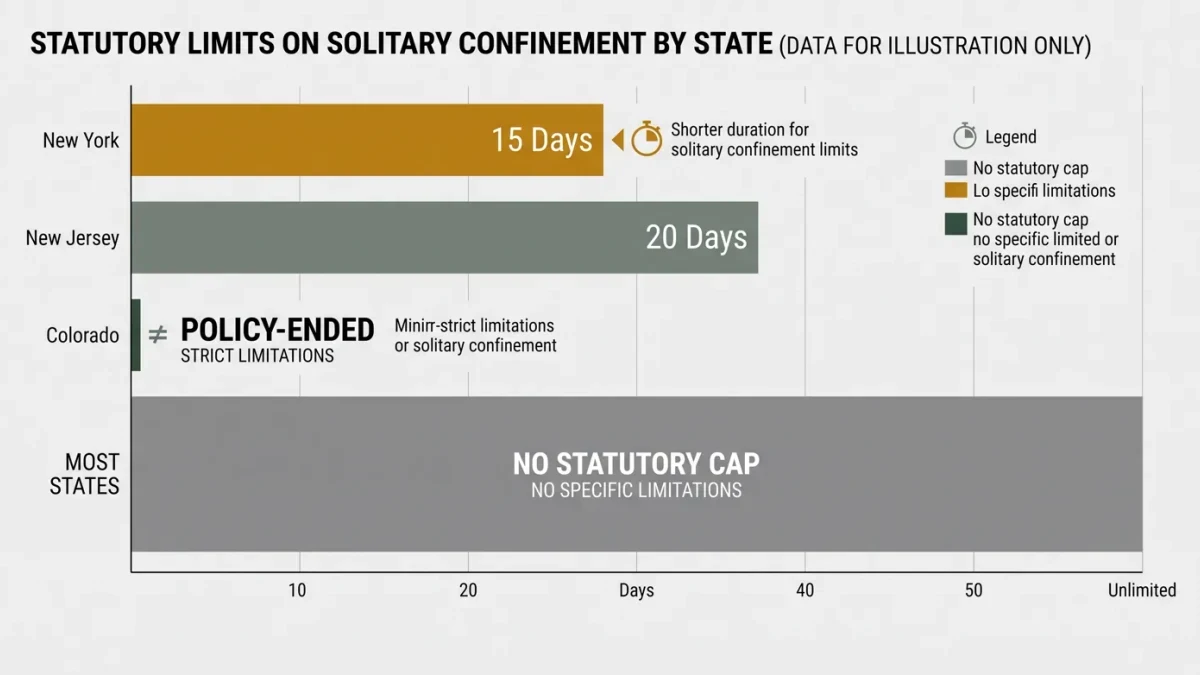
No federal law caps the duration of solitary confinement, and the rules that exist are almost entirely state-level and strikingly uneven: several states, including New York, New Jersey, and Colorado, now restrict the practice by statute or policy, while most impose no limit at all. Per the Bureau of Justice Statistics' census of correctional facilities, tens of thousands of people were held in restrictive housing on the survey reference date, with the national total estimated in the range of 40,000 to 80,000 on any given day depending on definition. A series of Senate inquiries beginning in the mid-2010s found roughly 2,000 people with serious mental illness in solitary in a single two-week snapshot.
What counts as solitary confinement?
Definitions drive every number. Corrections systems generally use the term restrictive housing or segregated housing: confinement apart from the general population, typically 22 to 24 hours a day in a cell, for administrative or disciplinary reasons. Advocates and researchers at the Arthur Liman Center at Yale, whose time-in-cell reports with the Association of State Correctional Administrators became the field's reference data, have tracked both the population and the length of stay — the variable that separates reform states from the rest, since even critics of the practice treat a few days differently from years.
Which states have acted, and how?
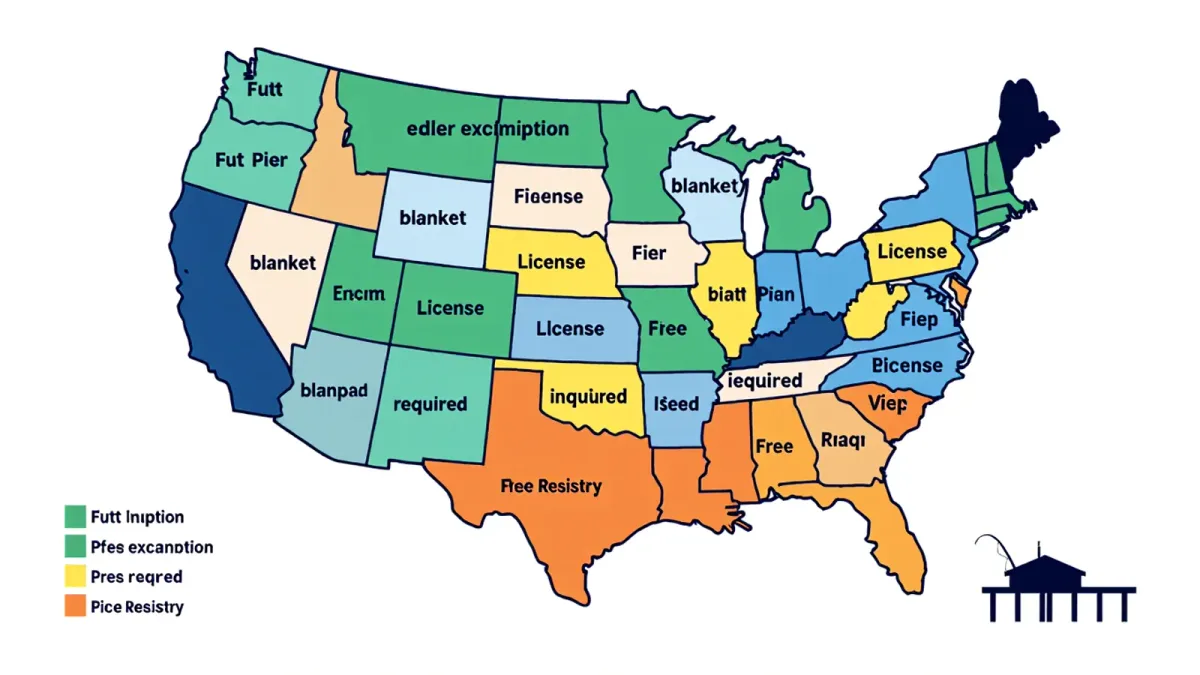
The strongest statutory limits cluster in a few states. New York's Humane Alternatives to Long-Term Solitary Confinement Act, passed in 2020, caps most disciplinary segregation at 15 days and created secure residential rehabilitation units as an alternative. New Jersey's 2019 law sets a similar 20-day cap and bars the practice entirely for vulnerable groups. Colorado announced in 2017 that its prisons would stop using long-term solitary, holding people alone only for brief periods during emergencies. Other states have acted through litigation or policy memos rather than statute, which makes those limits easier to change: a settlement binds a particular system, while a policy directive can be revised by the next administration.
| State | Limit | Basis |
|---|---|---|
| New York | 15 days for most disciplinary segregation | Statute (2020) |
| New Jersey | 20 days; ban for vulnerable groups | Statute (2019) |
| Colorado | Long-term isolation ended by policy | Department policy (2017) |
| Most states | No statutory cap | — |
Where does the 15-day number come from?
The Istanbul Statement on the Use and Effects of Solitary Confinement, an international convening of physicians and researchers, and later U.N. standards — the Nelson Mandela Rules, adopted in 2015 — placed prolonged solitary, defined as beyond 15 consecutive days, in the category of treatment that can amount to torture. U.S. courts have been slower: litigation under the Eighth Amendment typically turns on conditions and mental-health evidence in a specific facility rather than duration alone. Researchers have documented psychological harm — hypersensitivity to stimuli, hallucination, worsening depression — that can persist after release, and correctional administrators themselves have flagged the practice's poor record of improving institutional safety.
Who ends up in restrictive housing?
Department-level data, where states publish it, consistently shows two patterns: people land in restrictive housing disproportionately for lower-level infractions rather than violence, and the population over-represents people with mental illness. Federal data requests and state reports have repeatedly found that a substantial share of those held could not identify a recent serious disciplinary offense. The overlap with mental illness is what pushed several systems toward residential treatment units as alternatives — a design choice now being watched in evaluations of New York's replacement units, where early oversight reports flagged staffing and condition problems of their own.
Is federal reform coming?
Federal action has moved through the prison system it controls rather than national standards. The Federal Bureau of Prisons has issued policy directives limiting disciplinary segregation terms and restricting its use for people in palliative care or pregnancy, and the First Step Act of 2018 barred the practice for juveniles in federal custody. Broader bills — most prominently proposals to align federal practice with the 15-day standard and to push states through grant conditions — have been introduced in several Congresses without passage. In the absence of a federal floor, the state map remains the whole story, and the map is sparse.