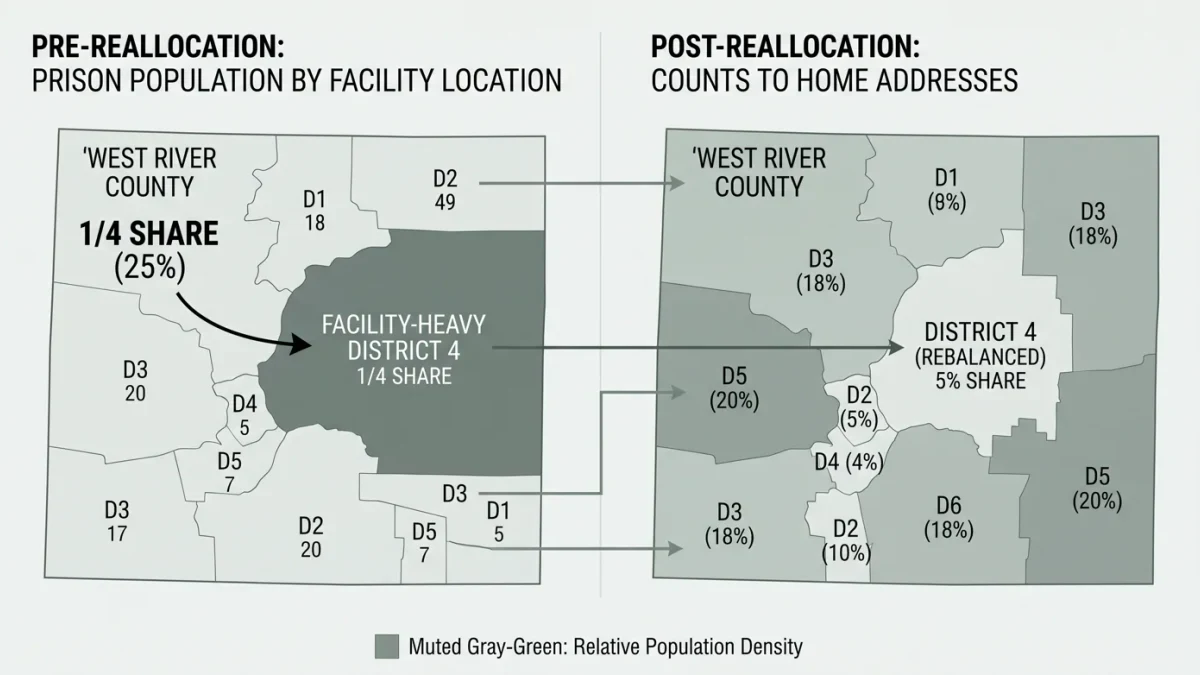
When a new prison opens in a rural county, the census counts the people inside it as residents of the prison's district — and for most of American history, redistricting then drew those bodies into the district's population base, even though people in prison generally cannot vote there and, in most states, cannot vote at all while incarcerated. Prison Policy Initiative's analyses — the reference research on the practice — documented districts where incarcerated people were a quarter or more of the counted population, and a national pattern in which prison counting inflated rural, whiter districts while draining population from the urban, disproportionately Black and Latino neighborhoods the incarcerated people came from. More than a dozen states, home to over half the national population, now end the practice by reallocating incarcerated people to their pre-incarceration addresses for districting.
Where did the practice come from?
Census residence rules, not statutes: the Bureau's usual-residence rule counts people where they live and sleep, which it applies to correctional facilities as group quarters — a rule that matched the reality of short jail stays poorly and long prison sentences not at all, since a person serving twenty years in a facility three counties from home is not a resident of that county in any ordinary sense. The Bureau's own 2010s review concluded that counting incarcerated people at facilities was not its best reading of usual residence but deferred change; in 2018 it announced it would not change the rule for 2020, and instead offered states a voluntary product — group-quarters counts with facility detail delivered early enough for states to reallocate themselves.
What have the states done?
Four states acted first for the 2010 cycle — Maryland and New York by statute, Delaware and California by statute with later implementation — and the wave grew to over a dozen for 2020, including Nevada, Washington, Virginia, New Jersey, Illinois, Pennsylvania's partial version, and Michigan's ballot measure. The mechanics: the state requests the census's prison-format file, matches incarcerated people to home addresses from Department of Corrections records, and adjusts the redistricting base. Address quality is the operational constraint — records with missing or unverifiable home addresses leave a residue counted at the facility, and states differ on whether that residue is excluded entirely or left in place.
Does it change anything measurable?
It has. The documented cases are concrete: in New York, post-2010 reallocation shifted population-weighted influence toward the urban districts prisoners came from and away from upstate senate districts built on prison counts, per the state's task force data; and at the county and city level — where one large facility can dominate a district entirely — reallocation rebalanced county boards in several reform states after 2020, with Michigan's first reallocation cycle redrawing local districts that had been drawn around facility counts. The dilution argument, formalized in the academic literature on malapportionment, holds that residents of home districts have their votes diluted when their neighbors are counted elsewhere — while the prison district's residents gain representation weight without representing the counted population.
What are the counterarguments?
Opponents — principally the receiving rural districts and some redistricting officials — argue that reallocation is itself a manipulation, that the census rule is a neutral residence standard, and that legislative bodies should not move population for political ends. Defenders answer with the representational arithmetic: a council district that is 30 percent incarcerated people gives its voting residents three times the per-vote weight of districts without prisons, which is the same defect one-person-one-vote doctrine polices elsewhere. Litigation has been sparse: courts have generally treated reallocation statutes as within state redistricting authority, and the Supreme Court's one-person-one-vote cases, from Reynolds v. Sims onward, count total population rather than voters, leaving states the choice the reform states exercised.
What should readers watch?
The next cycle: more states adopting reallocation before 2030, the Bureau's residence-rule question reopened or not, and — the upstream fact — the incarceration rate that makes the arithmetic matter. The people at the center of the practice remain counted somewhere without voting in most states; reallocation corrects where they are counted, and the franchise question is a different statute entirely.