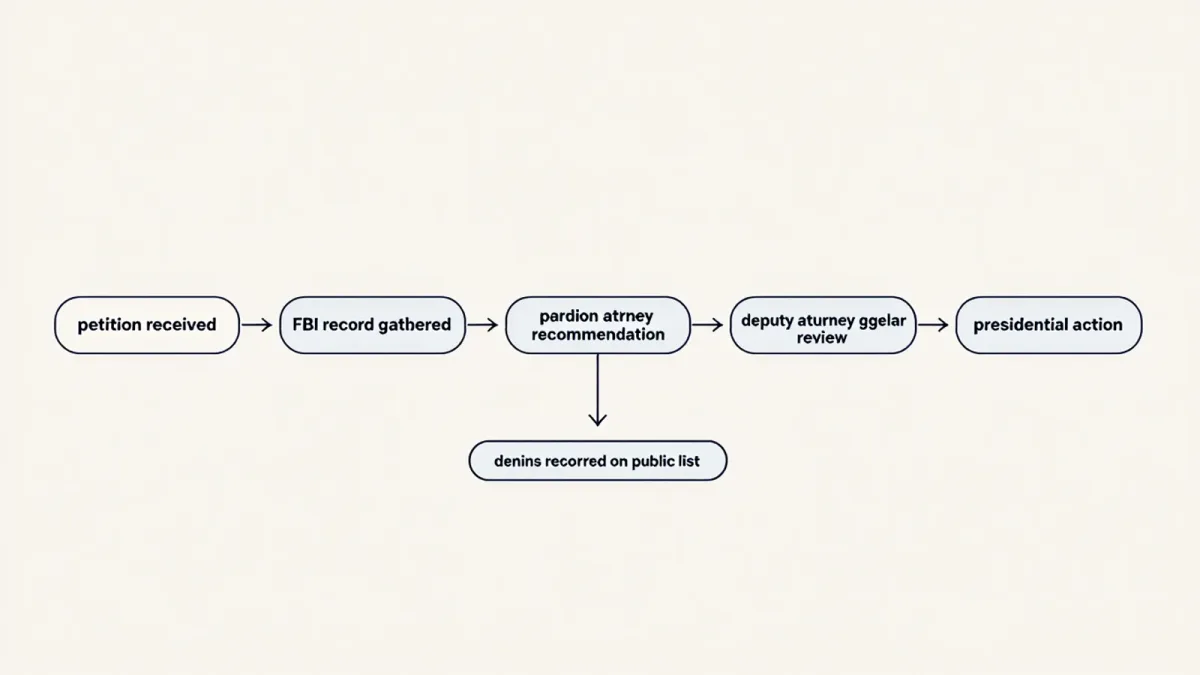
Clemency — pardons, which forgive convictions; commutations, which shorten sentences; and reprieves — is an executive power held by governors and the president with essentially no judicial review, per the Supreme Court's holding in Biddle v. Perovich (1927) and the modern cases reaffirming it. The scale is lopsided: the federal Office of the Pardon Attorney receives thousands of petitions annually and grants a relative handful; the 2024 holiday clemency actions and the 2025 pardons and commutations — including the mass clemency announced for people convicted of nonviolent drug offenses and people released to home confinement during the pandemic — moved thousands at once, illustrating the power's character as an unreviewable discretionary act that can be exercised case by case or wholesale. What varies is process, and process is where fairness questions live.
How does the federal process work?
A petition goes to the Office of the Pardon Attorney in the Justice Department, which reviews, requests input from the prosecuting U.S. attorney and the Bureau of Prisons, and recommends to the deputy attorney general and the president. Critics — including former pardon attorneys themselves, who have resigned publicly over the process — describe institutional conflict built in: the same department that prosecuted the case weighs the mercy petition, and the clemency function sits low in its priorities. Presidents have periodically bypassed the office entirely, announcing grants on their own timeline; the 2020s saw both party-standard grants and contested ones, including preemptive pardons whose validity some scholars question and no court has resolved, since a pardon's issuance and scope are largely political questions.
What do governors do differently?
Everything from formal boards to personal discretion. Roughly half the states have clemency boards — paroles-board style panels that investigate and recommend — and the rest run petitions through the governor's counsel or the corrections department. Several states require board recommendations before a governor can grant, which converts the board into the real gatekeeper: Oklahoma's and Georgia's boards, among others, have been studied for their recommendation-to-grant pipelines. A handful of states have all-but-abolished clemency through practice: governors who simply do not grant, leaving sentences fixed by prosecutors decades ago unchanged by any mechanism — the documented pattern in several death-penalty states, where clemency is the last check and its absence has preceded executions over juries' and prosecutors' own later objections.
What are the fairness findings?
Structural, and documented in the research on grants. Pardons skew toward applicants with lawyers and clean post-offense decades; commutations of drug sentences skew toward cases with publicity; and the racial patterns in grants have drawn studies in several states finding Black applicants less likely to receive favorable recommendations, echoing parole findings. The reform literature's answers mirror parole's: written criteria, published reasons, deadlines for decisions, and board independence — proposals adopted in a few states through executive order or statute and opposed elsewhere on the ground that clemency is meant to be personal, an act of grace that resists codification.
What is clemency for, doctrinally?
The Supreme Court has described it as a failsafe against the legal system's oversights — the remedy for the sentence that is lawful but wrong, the codefendant treated more harshly than the rest, the aging lifewire whose crime recedes. The Founders debated it explicitly, and Hamilton's Federalist 74 defense — that justice without access to mercy is too severe — remains the canonical statement. The modern debates are about the power's scale rather than existence: mass grants forgive categories rather than individuals, which critics call legislation by decree and defenders call the only proportional response to a sentencing era — the crack-cocaine disparity being the canonical case — that Congress itself has disowned but only partially retrofitted.
What should families and applicants know?
The mechanics are public: the federal application is free and does not require counsel, though the pardon-attorney statistics show represented applicants faring better; state procedures vary and several boards publish criteria and wait times. The record that matters is the decades after the case — employment, restitution, community letters — and the petition's function is to make that record legible to a reader with a thousand files. The power to grant is unreviewable; the power to apply belongs to anyone.