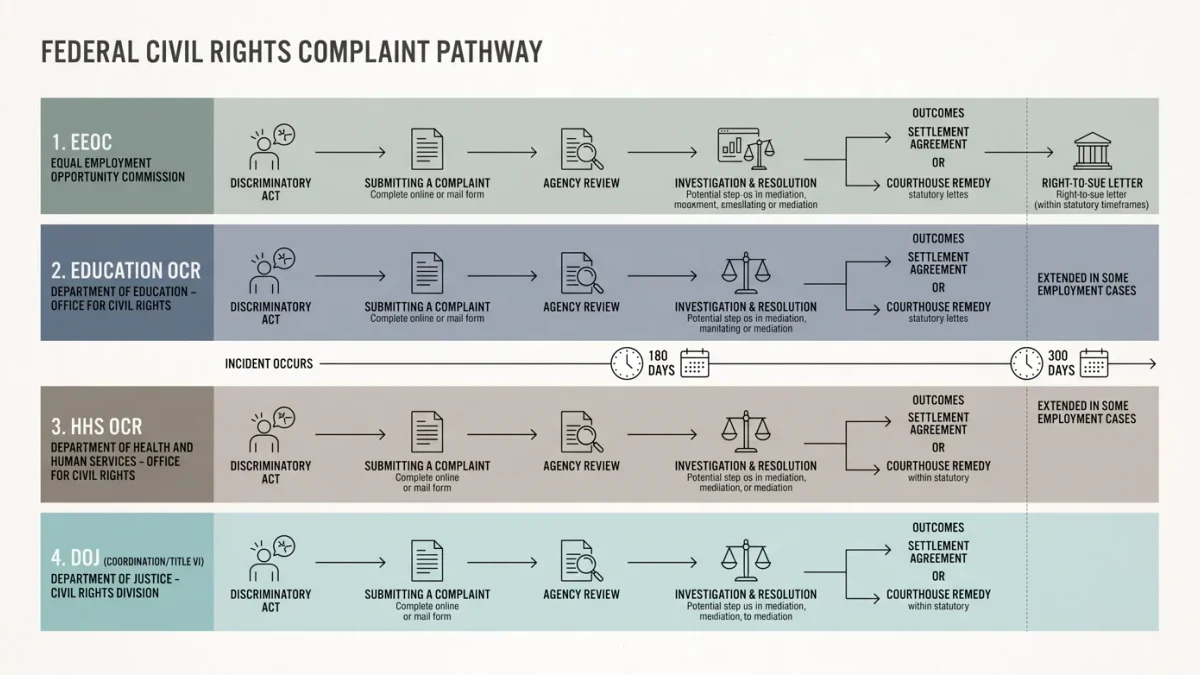
Filing a civil rights complaint usually starts not in court but at a federal agency: the Department of Education for schools, Health and Human Services for hospitals and state health programs, Justice for police and jails, and the Equal Employment Opportunity Commission for employers. Each office runs its own intake process, every one of them is free, none requires a lawyer, and all of them impose filing deadlines — commonly 180 days from the alleged act — that end the complaint if missed. News Bay 71 publishes information, not legal advice, and cannot file or evaluate individual complaints.
Which agency handles which kind of discrimination?
The split follows the civil rights statute and the money. Discrimination by an employer — race, sex, religion, national origin, age, disability, and genetic information — goes to the EEOC under Title VII and related laws. Discrimination by a school or college that receives federal funds goes to the Department of Education's Office for Civil Rights under Title IX, Title VI, and Section 504. Discrimination by a health-care provider, a state Medicaid program, or a social-services agency goes to HHS's Office for Civil Rights. Police departments, jails, and prisons raise different claims: the DOJ's Civil Rights Division handles pattern-or-practice investigations of systemic misconduct, while a single incident is often addressed through a private lawsuit under 42 U.S.C. § 1983 rather than an agency complaint.
What does a complaint need to contain?
Agency intake forms ask for the same core elements. The complaint must identify the person or institution that acted, describe what happened and when, and explain the protected basis — race, disability, sex, and so on — connecting it to the harm. It must be filed within the deadline, which runs from the discriminatory act rather than from when the filer discovered it in most schemes. The filer does not need legal citations; intake staff sort the statute. Including documents — letters, denials, medical or school records, dates of calls — accelerates the process substantially. Anonymous complaints are accepted by some offices, but they are harder to investigate and cannot produce remedies for the individual.
What happens after filing?
The office screens the complaint for jurisdiction and timeliness, notifies the institution, and either opens investigation, mediates, or dismisses. Federal civil rights offices do not represent the complainant; they enforce the statutes. Investigations commonly take months to more than a year. Outcomes vary: an Education Department finding can lead to a resolution agreement in which the institution changes policy; an EEOC finding of cause can support a lawsuit, and after 180 days the filer can request a right-to-sue notice and go to federal court regardless of what the agency concluded. Complaints also feed the public record — aggregate data from these offices is how researchers, journalists, and agencies see systemic patterns that no single filer would know about.
What are the deadlines that matter most?
Deadlines are the part of the process people most often lose on. EEOC charges are due within 180 days, extended to 300 days in states with their own fair-employment agencies. Education and HHS administrative complaints are generally due within 180 days of the act. A lawsuit under § 1983 follows state personal-injury statutes of limitations, which are typically one to three years. Title VII suits against private employers cannot be filed at all until an EEOC charge has been made and a right-to-sue notice issued. Because these clocks run independently, people with potential claims often file the agency charge early precisely to preserve every later option.
Can filing backfire?
Retaliation against a person for filing is separately illegal under every major civil rights statute, and retaliation claims are often easier to prove than the underlying discrimination because the causal link — complaint, then adverse action — is documented. That protection has limits: it covers adverse actions tied to the protected activity, not immunity from ordinary personnel or academic decisions. Some filers also weigh publicity: federal investigative files can surface later in litigation. Community legal-aid organizations and state bar referral services can review a complaint before filing at no or low cost.
Where do the forms actually live?
Each office posts its portal: the EEOC's Public Portal for charges, the Education Department's OCR complaint portal, and HHS OCR's online complaint form, with DOJ's Civil Rights Division reporting form for law-enforcement matters. Paper submissions by mail remain accepted everywhere. Filers should keep copies of everything submitted and the confirmation numbers the portals issue — those records are what investigators reference, and what a court will later want to see if the administrative route ends without a remedy.