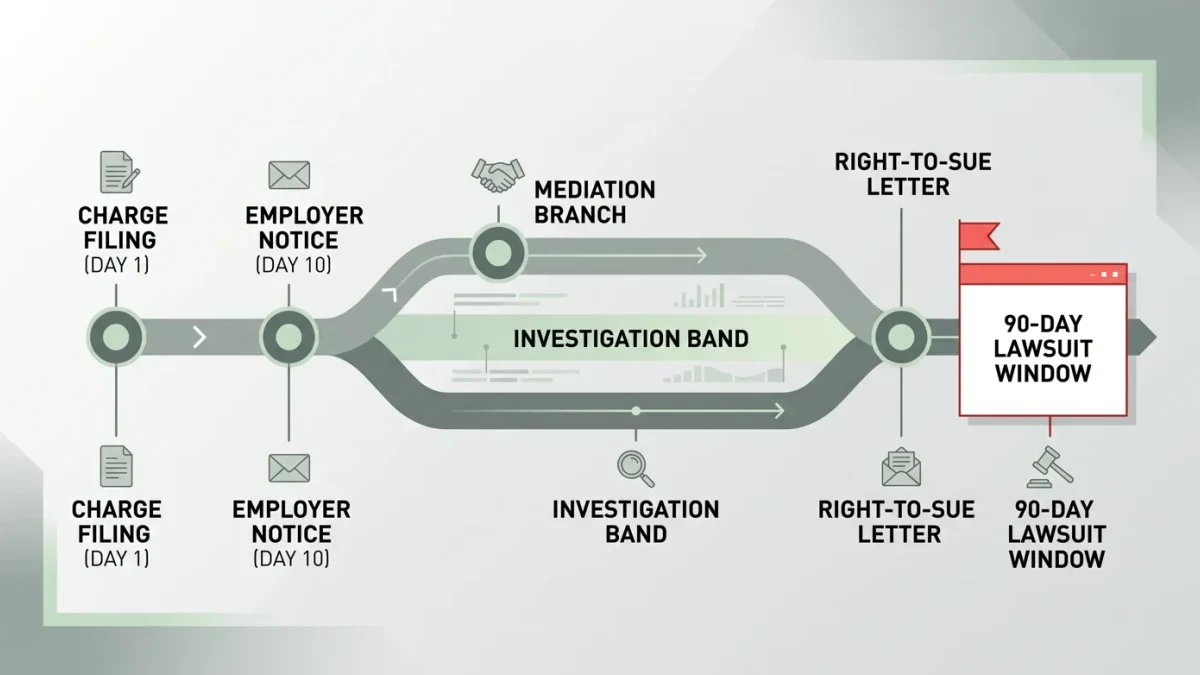
Before suing an employer for discrimination under federal law, a worker must file a charge with the Equal Employment Opportunity Commission — the exhaustion requirement that channels workplace claims through an administrative process first. The charge must be filed within 180 days of the discriminatory act, or 300 days in states with a state fair-employment agency that defers or shares jurisdiction. Per the EEOC's own performance statistics, the agency receives roughly 70,000 to 90,000 charges a year, resolves the large majority without litigation, and issues the right-to-sue letter that unlocks federal court. The process is free, requires no lawyer, and its deadlines run from the act itself, not from when the worker understood it — which is why the calendar is the first thing to check. News Bay 71 publishes information, not legal advice.
What happens after the charge is filed?
The employer is notified within ten days, and the EEOC typically offers mediation — a free, confidential settlement conference that resolves a meaningful share of charges quickly when both sides accept. Otherwise the charge enters investigation: intake interviews, position statements from the employer, document requests, and sometimes witness interviews. Outcomes are three: a cause finding, that discrimination likely occurred, leading the EEOC to pursue conciliation and possibly sue itself, which is rare; a no-cause finding, closing the administrative case but not the worker's; or no action and eventual closure, after which the worker can request the right-to-sue letter and file in federal court. The critical fact about all three: the administrative outcome does not bind the court, and no-cause findings do not prevent a successful lawsuit.
What is the right-to-sue letter?
The doorway to court. A worker can request it after 180 days from filing regardless of where the investigation stands, and must file the federal lawsuit within 90 days of receiving it — a deadline courts enforce strictly, with suits dismissed for days-late filings. The letter ends the agency process; from there the case is ordinary federal litigation, with discovery, summary judgment under the McDonnell Douglas burden-shifting framework, and remedies including back pay, reinstatement, compensatory damages capped by statute by employer size, and punitive damages in intentional cases within the same caps.
What counts as a discriminatory act — and when does the clock run?
Discrete acts — a firing, a demotion, a denied promotion — start their own clocks, per National Railroad Passenger Corp. v. Morgan (2002): a Title VII suit can reach only acts within the charge window, while hostile-environment claims can aggregate conduct reaching back in time if related and some act falls in the window. The distinction determines what evidence matters: a claim about a March termination filed in October is late, but a hostile-environment charge capturing an ongoing pattern is not. Pay-discrimination claims run on a separate rule under the Lilly Ledbetter Act: each discriminatory paycheck restarts the clock for compensation claims.
What should the charge itself contain?
The minimum is personal information, employer identification, dates, and a short description of what happened and on what protected basis — race, sex, age, disability, religion, national origin, retaliation. Details matter less than accuracy at intake; the charge can be amended to add facts, though claims not fairly encompassed by the charge's scope are barred from the later lawsuit, which is the exhaustion rule's bite. Retaliation deserves emphasis: it is the most-filed charge category in recent EEOC statistics, usually added to another basis, and filing a charge is itself protected activity that makes subsequent adverse action separately actionable.
What are the limits to know about?
Who is covered: private employers with 15 or more employees (20 for age claims), with different rules for federal workers, who must contact an EEO counselor within 45 days, and union workers, whose contracts may add grievance paths. What the process cannot do: the EEOC does not award interim relief, cannot stop the underlying conduct during investigation, and its backlog means investigations commonly take ten months to over a year. The system's design assumes the worker survives the process — financially and professionally — that precedes any remedy, which is the practical fact every employment attorney raises first.