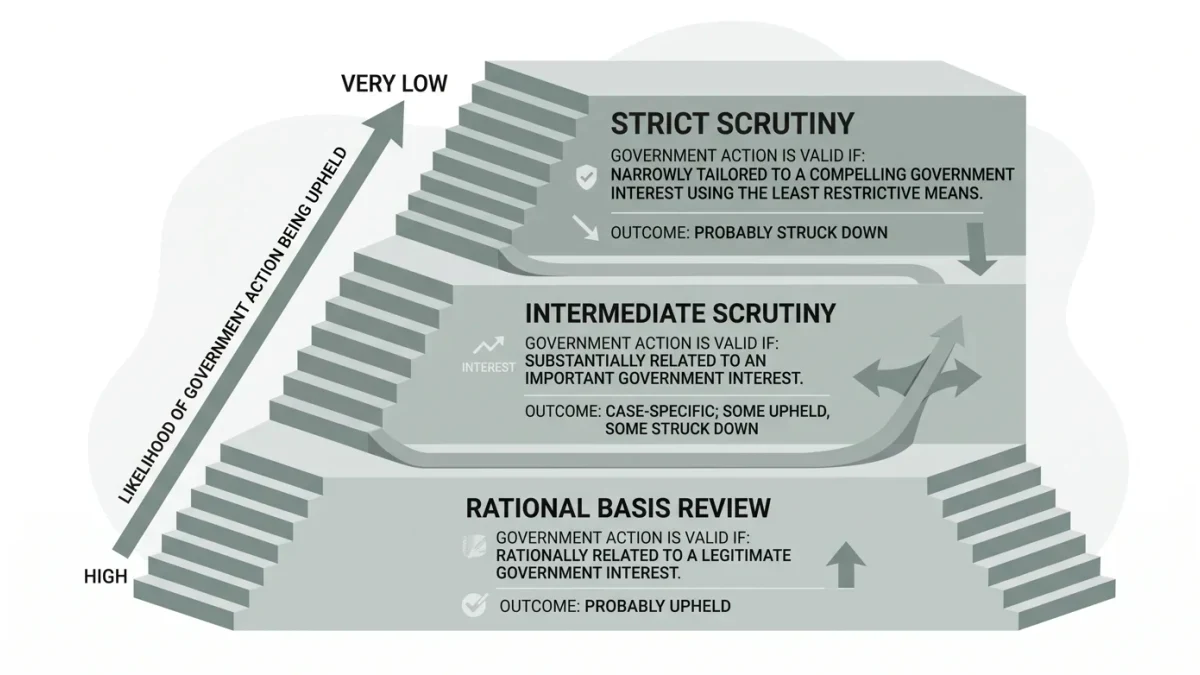
The Equal Protection Clause of the Fourteenth Amendment — no state shall deny any person equal protection of the laws — is one sentence, but federal courts read it as three different commands depending on who is being treated differently. Race and national origin trigger strict scrutiny, requiring the government to prove its classification is necessary to a compelling interest, a test that survives only in narrow cases. Sex and legitimacy trigger intermediate scrutiny: substantially related to important objectives. Everything else gets rational-basis review, a test the government nearly always wins. Which tier applies is therefore the litigation: per the Supreme Court's docket history, the classification decision — often argued as a preliminary question — frequently determines outcomes in affirmative action, school assignment, benefits, and ballot-access cases alike.
Why do the tiers exist?
The framers of the Fourteenth Amendment wrote one command; the tiers are judge-made doctrine from the twentieth century, crystallized in United States v. Carolene Products's famous footnote 4 (1938), which suggested that classifications touching discrete and insular minorities, political processes, or enumerated rights deserve harder looks. The logic is that courts should distrust classifications aimed at groups with little political power, and trust democratic processes otherwise. Critics across ideological lines note the doctrine's circularity — a group's powerlessness is proven by the doctrine's failure to protect it — and its founders' original purpose, documented in Reconstruction history, was specifically to secure the rights of formerly enslaved people, a purpose the modern Court has consulted in cases like Students for Fair Admissions (2023), which ended race-conscious college admissions by holding them to strict scrutiny and finding them wanting.
How does strict scrutiny actually work?
Strictly, and rarely to the government's benefit. The interest must be compelling — in practice, remedying documented past discrimination by the specific government unit, or prison security — and the means must be necessary, with no race-neutral alternative. Government survives in single digits of percentage terms historically: the wartime internment upheld in Korematsu (1944) was the paradigmatic failure, repudiated explicitly by the Court in 2018 in Trump v. Hawaii even while it upheld the travel ban at issue there. Defenders of the tier argue that is the point: racial classifications, whatever their direction, get no benefit of the doubt. Challengers of race-neutral policies with disparate impact — voter ID, zoning, school finance — face the opposite problem: under Washington v. Davis (1976), discriminatory impact alone is not enough; purpose must be shown, usually through circumstantial evidence, per the Arlington Heights factors.
What about sex and other classifications?
Intermediate scrutiny, built by Craig v. Boren (1976) and the litigation over women's military and school admissions, requires exceedingly persuasive justifications — the phrase from United States v. Virginia (1996), which opened the Virginia Military Institute to women. The tier's signature modern battles are reproductive and trans-inclusive ones: whether pregnancy discrimination is sex discrimination, and how heightened review applies to trans plaintiffs, where appellate courts have increasingly applied intermediate scrutiny without a definitive Supreme Court holding. Age, disability, wealth, and — under City of Cleburne (1985), formally — intellectual disability sit at rational basis with teeth in some applications, while sexual orientation gained real scrutiny only via Windsor and Obergefell through a mix of equal-protection and due-process reasoning the Court has never cleanly labeled.
What is the federal analogue?
Equal protection binds states; the federal government answers to the Fifth Amendment's due-process clause, which incorporates equal protection through Bollinger-era doctrine — the same tiers, applied via reverse incorporation. That is why federal set-asides and federal admissions policies face the same strict scrutiny as state ones, and why classification questions after Students for Fair Admissions have moved to program design: military academies' diversity interests, employment proxies, and geographic and socioeconomic criteria that do not name race but are litigated over whether they smuggle it in.
What should readers take from the doctrine?
That equal protection is not a general anti-unfairness clause. It is a set of presumptions about which differences matter: race almost never survives, sex survives with real justification, and wealth — the classification most relevant to criminal justice, education finance, and voting — sits at the bottom tier, a placement civil-rights scholars have criticized since the doctrine's formation. The tiers are why a policy's description is the fight: name the classification, and you have usually named the winner.