Two European regimes now require large companies to identify and address human-rights harms in their supply chains, and both reach U.S.-based multinationals through their European operations and sales. Germany's Supply Chain Due Diligence Act, in force since 2023, obliges companies with significant German operations to conduct risk analysis, take preventive and remedial action, and report publicly. The European Union's Corporate Sustainability Due Diligence Directive, adopted in 2024 after the world's largest companies lobbied over its scope, phases in from 2027 onward for the largest firms, requiring them to identify, prevent, mitigate, and account for adverse human-rights and environmental impacts in their chains of activities — with penalties reaching a share of global turnover and civil liability for damages.
What do the laws actually require?
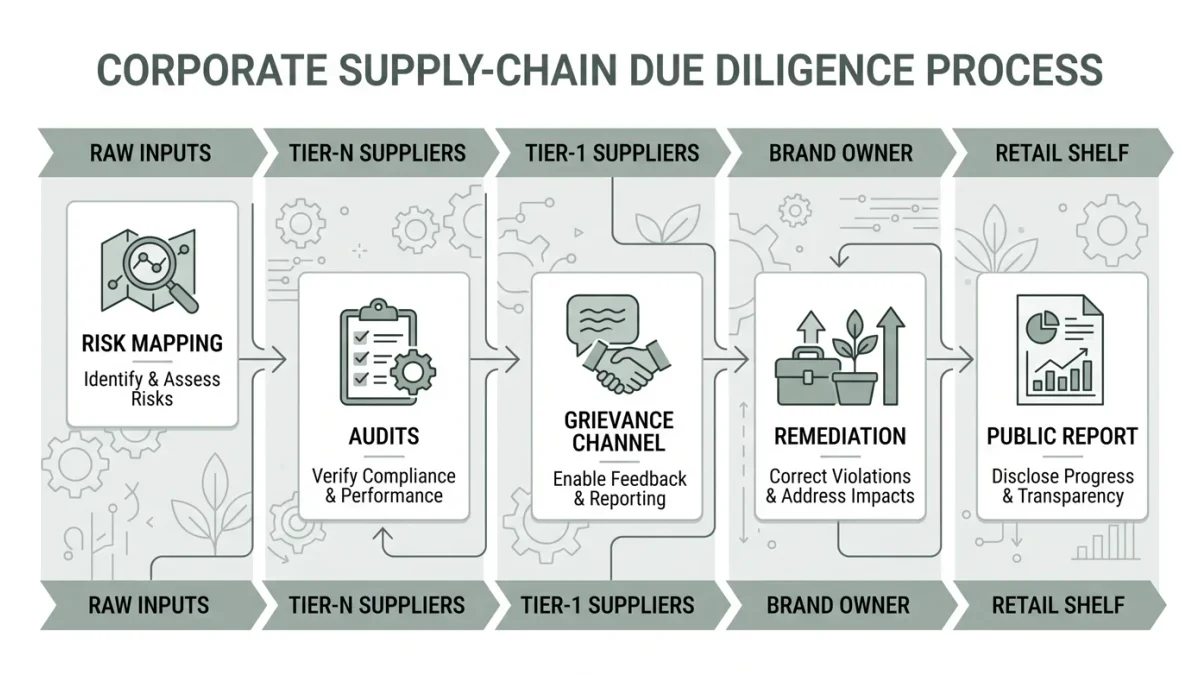
The architecture follows the U.N. Guiding Principles on Business and Human Rights, the 2011 framework that defined companies' responsibility to respect rights independently of legal duty. Concretely: map the supply chain to identify risk; embed responsible purchasing practices — because pricing and delivery pressure are themselves causes of forced overtime and unauthorized subcontracting; conduct human-rights due diligence with stakeholder consultation; remediate harms found, which means fixing outcomes for affected workers, not merely ending the relationship; and disclose. The German statute adds a complaints mechanism workers and third parties can use, and its enforcement agency, the Federal Office for Economic Affairs and Export Control, has powers to audit and fine, with enforcement reported as ramping gradually since 2023.
How deep into the chain does the duty reach?
Deeper than contract law goes on its own. The EU directive distinguishes the company's own operations, established business relationships, and downstream use — with the strictest duties at the top tiers and risk-based duties extending to the chain of activities where harms are plausible. In practice the hard cases are tiers three and below: the smelter, the gin, the recruitment agency. Corporate traceability programs — blockchain pilots aside — now center on joining third-party audit schemes and disclosure bodies, which critics in the human-rights field describe as partial answers: audits announced in advance detect little, and social audits specifically failed to surface forced labor in multiple documented cases, which is why import regimes like the Uyghur Forced Labor Prevention Act reject them as sufficient evidence.
What are the sanctions and who can sue?
Germany caps fines in the millions of euros and — a provision with real market effect — excludes seriously violators from public procurement for up to three years. The EU directive requires penalties designed to be proportionate and dissuasive, with turnover-based ceilings, and gives affected persons a right to claim damages where a company failed required due diligence, subject to a liability shield for compliant diligence. Civil society organizations can support claims under conditions member states define. Trade unions and NGOs have already filed the first complaints under the German act — against several multinationals across apparel, retail, and raw materials — testing whether administrative rather than private enforcement carries the regime's practical weight.
What does this mean for workers?
The regimes' designers intend market pressure to reach working conditions: purchasing companies must price and schedule orders so suppliers can comply with law, must remediate rather than merely cut suppliers — a design responding to the documented pattern of codes of conduct followed by summary withdrawal when violations surface, which transfers harm to the workers found exploited. Skeptics, including development economists and some Southern governments that formed negotiating blocs against the directive, argue the rules function as trade barriers and burden smaller suppliers with audit costs. Early implementation evidence is thin; the German agency's first enforcement reports describe procedures more than outcomes.
What should buyers of U.S. companies watch?
The overlap of regimes is the practical story: EU due-diligence duties, the UFLPA's import presumption, U.S. customs actions, and state-level court litigation under the Alien Tort statute's modern remnants all pull the same documentation — chain-of-custody records, recruitment-fee policies, grievance channels. Companies that built systems for one regime are reusing them for the others, and the disclosure filings of listed companies increasingly describe those systems in risk-factor language. The direction is consistent: ignorance of the chain is ceasing to be a defense anywhere it matters commercially.