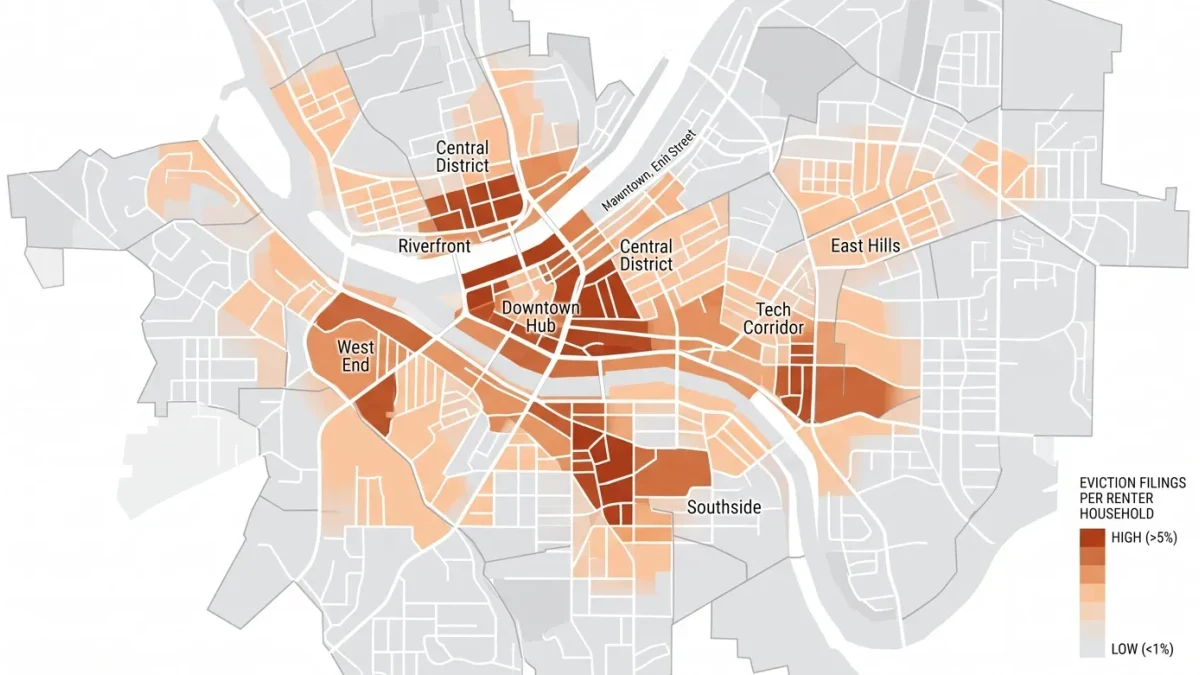
An eviction filing becomes a public record the day it is docketed, and tenant-screening companies sell access to those filings for years afterward — including filings the tenant won, filings that were dismissed, and filings that ended in a negotiated move-out. Roughly 3.6 million eviction cases were filed in the portion of the country covered by the Eviction Lab at Princeton University's tracking in a recent typical year, and research has shown that a filing alone, regardless of outcome, sharply lowers a renter's chance of being offered a lease. Since 2021, a growing list of states and cities has responded with record-sealing laws that limit what screening companies can see and sell.
Why is a filing itself so damaging?
Landlords screen on filings, not judgments. A court record that a case was filed and dismissed reads, in a database, the same as one that ended in a writ of possession. The design is the harm: tenant-screening algorithms flag names, and studies — including the Milwaukee-area research underpinning Matthew Desmond's eviction work and subsequent analyses by the Federal Reserve Banks — have found landlords reject applicants with recent filings at high rates. The stigma is racially patterned because filings are: eviction rates for Black renters, and especially Black women, run several times the white rate in every dataset that measures them, per the Eviction Lab's county-level statistics.
What do sealing laws actually do?
Three designs are in use. Automatic sealing closes records after a case ends in the tenant's favor — dismissal, defense verdict, or payment — without the tenant asking. Limited automatic sealing covers categories the legislature prioritizes, such as cases filed during declared emergencies or cases with no judgment. Petition-based sealing requires the tenant to file a motion and often show cause, which places the burden on the person least positioned to carry it. Leading automatic-sealing statutes include California's broad 2024 law, Illinois's court-rule-based sealing, Colorado's, Minnesota's, and New York's 2024 legislation limiting access to eviction records; more than a dozen jurisdictions have adopted some form since the pandemic-era eviction filings made the stakes visible.
What is excluded, and why does that matter?
Nearly every statute carves out cases in which the landlord obtained a judgment for serious cause — documented lease violations, nuisance, safety issues — and preserves access for the parties, courts, and sometimes researchers. The policy argument is about the base rate: in a large share of filings nationally, tenants lose by default rather than after contesting the merits, often over amounts later paid, and the record contains no adjudication of anything. Defenders of open records, including screening-industry trade groups, argue sealing reduces landlords' information and raises screening costs; researchers at the Urban Institute have noted the empirical record on both sides remains thin and that implementation quality — court data practices, compliance by screening firms — varies widely.
Do the laws reach the screening companies?
Only partly, which is the compliance frontier. Sealing orders bind courts, but the databases screening firms maintain are built from bulk court data purchased as it is docketed. Statutes therefore increasingly include duties on consumer-reporting agencies: a time limit on reporting a filing absent a judgment, and a duty to update on sealing. The federal Fair Credit Reporting Act supplies the enforcement backbone — reporting sealed or stale data can support a dispute and an action before the Consumer Financial Protection Bureau — but tenants rarely know these rights exist. Housing attorneys describe the practical sequence: seal first, then dispute the stale entry with each screening company in writing, keeping records throughout.
What can renters do in the meantime?
In jurisdictions without sealing, the levers are narrower. Renters can dispute inaccuracies with screening companies under the Fair Credit Reporting Act, ask courts to expunge individual cases on equitable grounds where state law allows, and present landlords with the actual case outcome — a certified dismissal carries more weight than silence. Some local right-to-counsel programs, now operating in dozens of cities after evaluations showed eviction representation cuts executed evictions dramatically, also prevent the filing that starts the record. The sealing movement's premise is simpler: the best record to seal is the one that never becomes a scar — but for the millions already docketed, the statutes are the only remedy on the table.