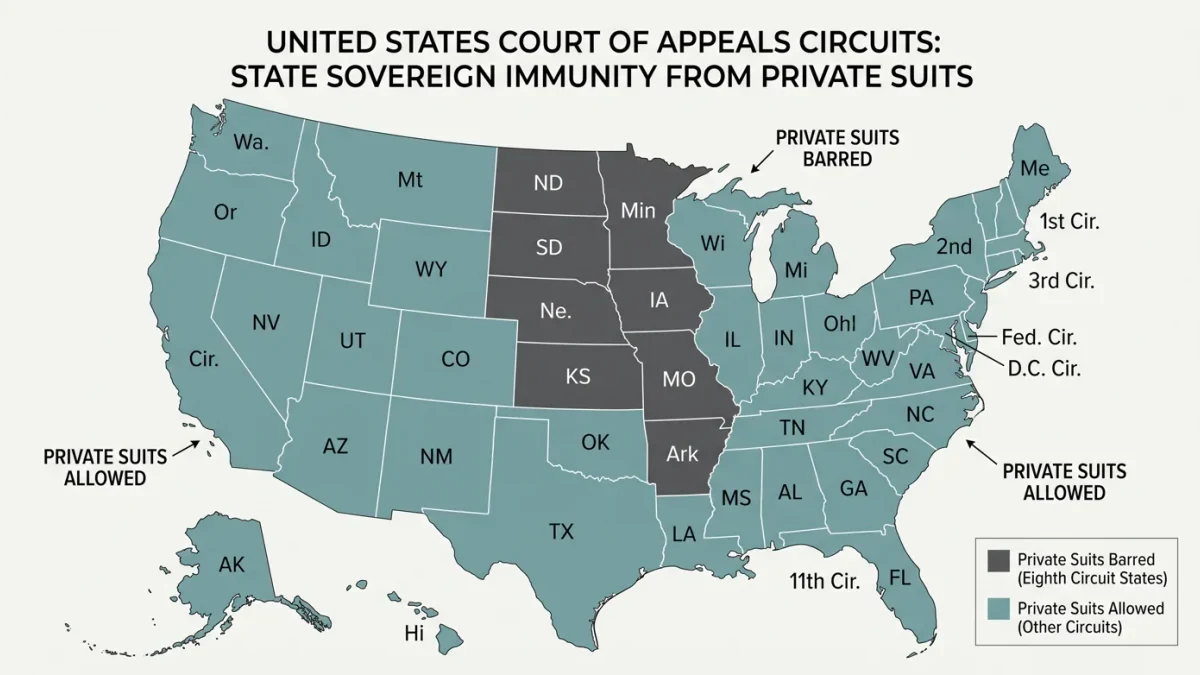
In much of the Midwest, private organizations can no longer sue to enforce Section 2 of the Voting Rights Act, the provision that prohibits racially discriminatory voting rules, because the Eighth Circuit held in late 2023 that only the federal government can bring such suits. Per the ruling in Arkansas State Conference NAACP v. Faulkner County, affirmed by the full court over a dissent, the statute's mention of the attorney general as plaintiff means private plaintiffs lack a private right of action — a reading no appellate court had adopted in the four decades since the 1982 amendments. The Supreme Court has twice declined to resolve the question, first by dismissing a case as settled after Arkansas rewrote its maps and later by avoiding the issue in a Louisiana dispute, leaving a nation where the same discriminatory map is actionable in some circuits and untouchable by citizens in others.
Why does private enforcement matter so much?
Because the Justice Department is one litigator with a political calendar, and the history of the Act is largely the history of private suits. Studies of Section 2 litigation, including academic tallies of voting-rights dockets, have found the substantial majority of cases brought by private plaintiffs and civil-rights organizations: the Arkansas case itself began as a private challenge to state house districts that a district judge found diluted Black voters' strength. If private suits disappear in a circuit, enforcement in those eight states — the Dakotas through Arkansas and Missouri — depends on DOJ resources and priorities, which change with each administration.
What did the Eighth Circuit actually rely on?
The panel majority read Section 2's text: the key sentence says the attorney general or an aggrieved person may institute proceedings, but a later subsection enumerating remedies refers to the attorney general's authority. From that drafting, the court inferred that Congress intended only governmental enforcement. The dissent and the Fifth Circuit's contrary en banc holding in a Texas redistricting case — which catalogued decades of appellate practice, Senate reports from 1982, and the canon of consistent interpretation — read the same text as obviously preserving private suits. The historical record is lopsided: courts, including the Supreme Court, adjudicated private Section 2 claims for forty years without questioning standing, and the 1982 legislative history speaks of aggrieved citizens bringing actions.
What has happened in the Eighth Circuit since?
Practical consequences documented by election-law trackers: challenges to local districting and polling changes filed by civic groups have been dismissed at the threshold in the circuit, while identical claims proceed elsewhere. Organizations have rerouted — filing constitutional claims under the Fourteenth and Fifteenth Amendments, which private plaintiffs can always bring, at the cost of a stricter intent standard than Section 2's results test. DOJ has picked up some matters, including in Arkansas after the private suit failed, and declined others. The circuit split also creates a forum-shopping incentive for defendants: procedural rules on where voting cases can be filed influence which appellate law governs.
What is the Supreme Court waiting for?
Certiorari denial is not endorsement, and both of the Court's vehicles dissolved on justiciability grounds — mootness in one, and in the Louisiana case a settlement — rather than a decision that the question was unworthy. Election-law commentators across the spectrum, from the Brennan Center's analysts to conservative election-law scholars, expect the issue to return: the conflict between circuits is square, and the practical stakes — the enforceability of the Act's central provision — are exactly the kind of division the Court exists to resolve. Until it does, lawyers describe the map as the holding: a right that exists west of the Mississippi's eastern bank and vanishes on its western side is, whatever the statute says, two different rights.
The through-line for readers watching 2026's redistricting litigation: check who the plaintiff is. If the caption names an organization, the case tests whether private enforcement survives; if it names the United States, it tests whether the current Justice Department chooses to spend its litigation budget there — and both are now political questions in a way the 1982 Congress did not intend.