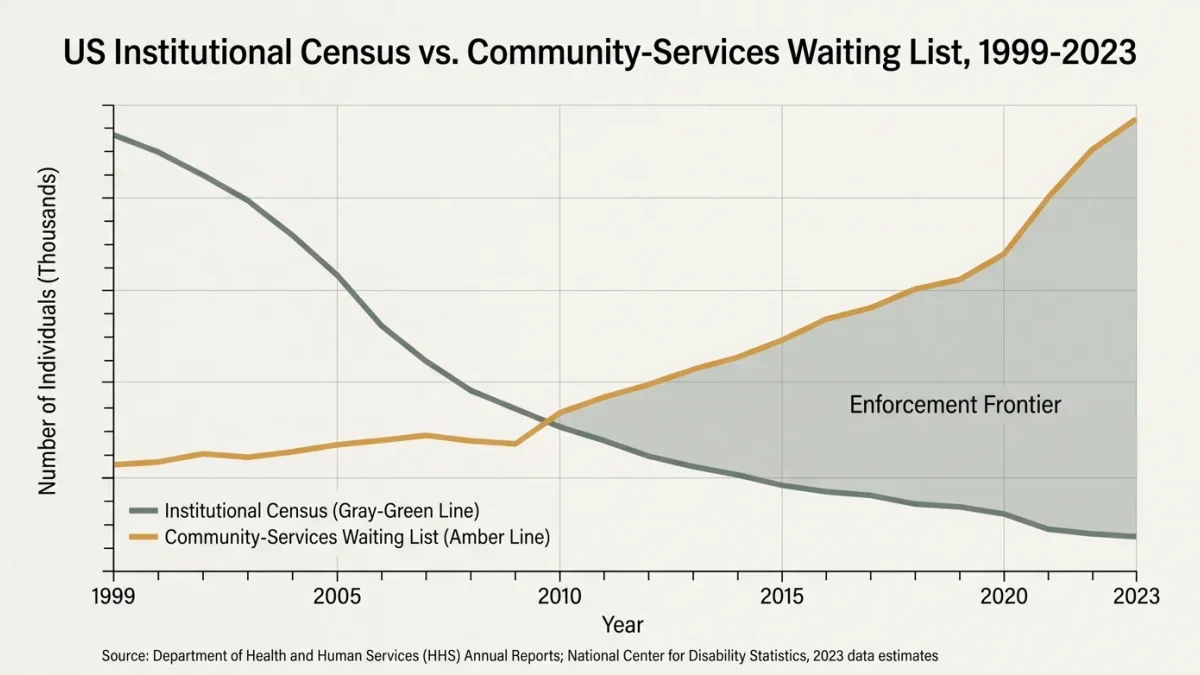
In Olmstead v. L.C. (1999), the Supreme Court held that unjustified segregation of people with disabilities is discrimination under the Americans with Disabilities Act, and that states must provide community-based services when professionals agree they are appropriate, the person wants them, and resources allow. Twenty-six years later, the decision is the operative civil-rights mandate in disability policy: it moved institutional populations into community settings at historic scale — state institutions for people with intellectual disabilities closed by the dozens, with census counts falling per University of Minnesota's institutional projects — while the enforcement frontier shifted to the people still waiting: hundreds of thousands of people on Medicaid home-and-community-based services waiting lists, in some states for years, per program data compiled by KFF.
What does Olmstead actually require of a state?
Reasonable pace. The decision itself left the compliance standard flexible, and the Justice Department's enforcement — hundreds of settlements, findings letters, and intervention briefs since 2009, when the department announced a Olmstead enforcement priority — filled in the doctrine: states must have comprehensive working plans for placing people in less restrictive settings, with measurable targets and waiting-list movement; refuge in budgetary strain is limited, because the ADA's reasonable-modification framework asks whether the state can honor the mandate when resources allow. The settlements' recurring terms: transition plans with numbers and dates, crisis-services capacity so communities can accept people, and closure timelines for institutions whose populations cannot lawfully remain.
What has changed since 1999?
The institutional map, mostly. Large state-run institutions — the developmental centers and psychiatric hospitals of the twentieth century — closed or shrank dramatically: the institutional censuses tracked by the University of Minnesota's Research and Training Center show state populations in large IDD facilities falling by well over half since the decision, with dozens of facilities closed. Money followed through Medicaid structure: the home-and-community-based services waiver system, which states use to fund community support, grew to serve far more people than institutions ever did. Two failures persisted: the waiting lists, which in a substantial group of states stretch over a hundred thousand people and multi-year waits; and the quality frontier — settings so large or regimented that they reproduce institutional life in the community, which the federal settings rule, finalized in 2014 and implemented through the 2020s, was written to police.
What are the current fights?
Three. Workforce: the direct-support workforce crisis — vacancy and turnover rates documented in every industry survey — is now the binding constraint on community capacity, and litigation has begun treating staffing as the place states' plans meet reality. Litigation scope: Olmstead principles extended beyond classic institutions to segregated employment (sheltered workshops, in the Lane v. Oregon and subsequent line of cases), to people in nursing facilities who could live at home, and to children needlessly institutionalized for want of home nursing — extensions the courts have largely accepted. And funding structure: the Medicaid institutional bias — federal law requiring institutional coverage while community coverage runs through discretionary waivers — remains the statute's built-in headwind, with the five-year extension of the Money Follows the Person rebalancing program the recurring congressional vehicle for closure.
Who enforces it now?
The Justice Department, through ADA Olmstead investigations and settlement agreements, remains the primary engine, with cases including state systems from Georgia's developmental and psychiatric settlements onward. Private litigation under the ADA's integration regulation — supported by Cummings-line access rulings — proceeds through class actions brought by disability-rights organizations, with remedies in transition services rather than damages. State protection-and-advocacy organizations, the federally mandated watchdogs, investigate and refer. The metric that matters to the person waiting is the list: where the state stands, how fast it moves, and whether the community slot that opens comes with a workforce to staff it.
What should readers watch?
The waiting-list counts in their state's HCBS program; the workforce data in the same budget documents; and the DOJ docket, where the next round of settlements is being drafted. The mandate is a quarter-century old, the direction is not in dispute, and the arithmetic of pace — people waiting, slots funded, staff hired — is published every year.