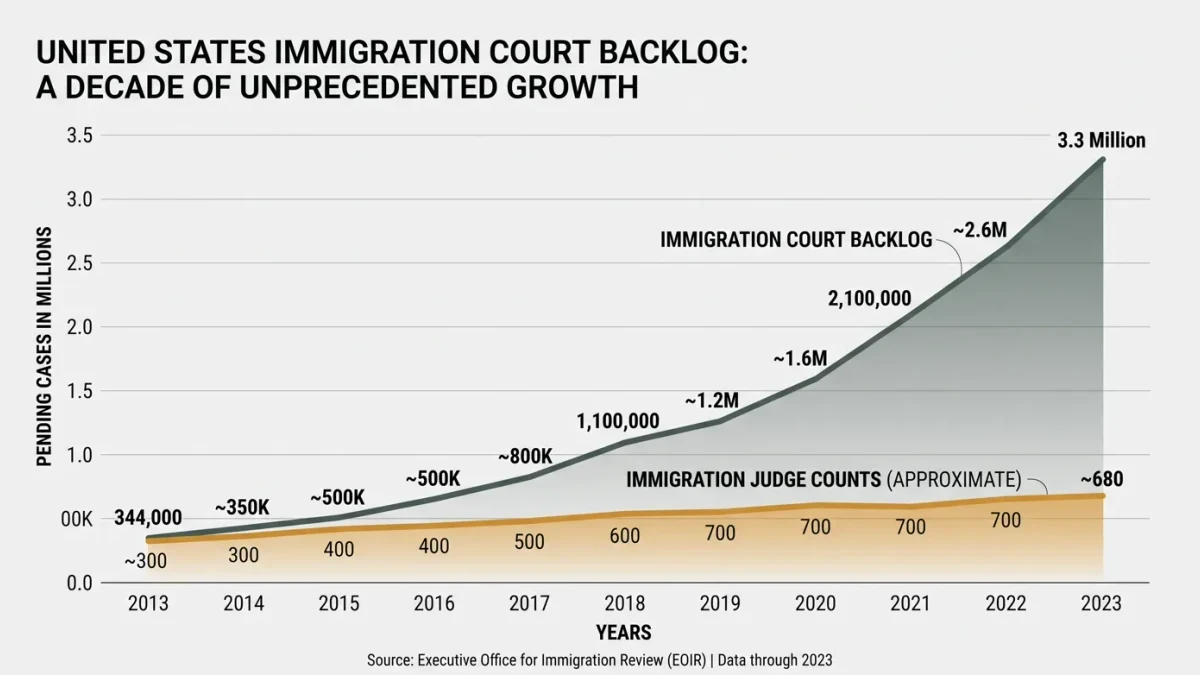
The backlog of pending cases in U.S. immigration courts passed 3.5 million in the federal counts of the mid-2020s, per the Executive Office for Immigration Review's published statistics and the Transactional Records Access Clearinghouse's case-by-case tracking at Syracuse University — a caseload assigned to roughly 700 immigration judges, an average of several thousand cases each. People in removal proceedings now wait years for hearings that the Constitution's due-process framework treats as urgent: detention or liberty, family separation, and removal itself all hang on the process. The backlog is the system's central fact, and every policy argument about immigration courts is now, at bottom, an argument about queue design.
Why is there a backlog?
Structural mismatch. Case volume — enforcement surges, asylum filings driven by conditions abroad, and program changes that redirect existing caseloads — moves in years, while judge hiring and court infrastructure move through appropriations cycles. The 2020s added whiplash: pandemic-era closures, then the replacement of some judge caseload with streamlined asylum screening; Title 42's end redirecting people from expulsions to proceedings; and 2025's enforcement expansion, which TRAC's docket analyses showed shifting new cases toward detained and expedited dockets — where hearing timelines run weeks — while the nondetained line, where most families wait, stretched further. Cancellation and rebooting of programs (parole, asylum rules) each moved hundreds of thousands of cases between statuses, resetting clocks.
What does a years-long wait mean in practice?
For respondents, documented by legal-aid organizations and the American Immigration Council's analyses: work permits that expire into processing backlogs, children who age through the system, evidence and witnesses that dissipate, and hearings set and reset — with notice practices, per litigation in several circuits, that fail to reach people who moved. For the government: detention costs for people who could be supervised — alternatives-to-appearance programs show appearance rates in the high nineties, per their own reporting — and an asylum system whose credibility rests on decisions rendered five years after arrival. For courts: judges managing dockets with continuance patterns that TRAC's data shows stretching median case completion toward five years for nondetained matters.
Is legal representation available?
For a minority. Immigration proceedings are civil: no appointed counsel exists, and representation rates run about half overall — far lower for detained people, around 14 percent per TRAC's representation analyses — with outcomes starkly divergent: represented respondents succeed at several times the rates of unrepresented ones in the same court systems, a disparity the research controls imperfectly but that every study confirms in direction. The right to counsel at government expense for unaccompanied children, partially funded in recent appropriations cycles, is the exception proving the rule; universal-representation pilots in cities including New York, and state-funded programs in California and elsewhere, have shown appearance and outcome improvements that their evaluations attribute to counsel's mere presence.
What fixes have been tried?
The oscillation itself is the story: each administration rewrites the case-management rules — prioritization memos, docketing orders, dedicated dockets for families and recent arrivals, video-teleconferencing expansion, and the judge hiring surges that appropriations funded in waves. The durable findings across all of it, per the Government Accountability Office's periodic reviews: hiring judges alone cannot outrun intake; procedural streamlining trades accuracy for speed at measurable cost; and the appeals layer — the Board of Immigration Appeals and the circuit courts — absorbs every rule change with a lag measured in years. Proposals for Article I immigration courts, taking the courts out of the enforcement agency that houses them, recur in bar-association and commission reports and in bills that have not advanced.
What should readers watch?
TRAC's monthly docket counts, which move with enforcement policy faster than any annual report; the detained-docket share, which is the speed-accuracy dial; and representation funding, which is the due-process dial. The backlog is not weather — it is the sum of choices about intake, process, and staffing — and its million-case increments are the clearest measure of those choices' consequences for the people standing in it.