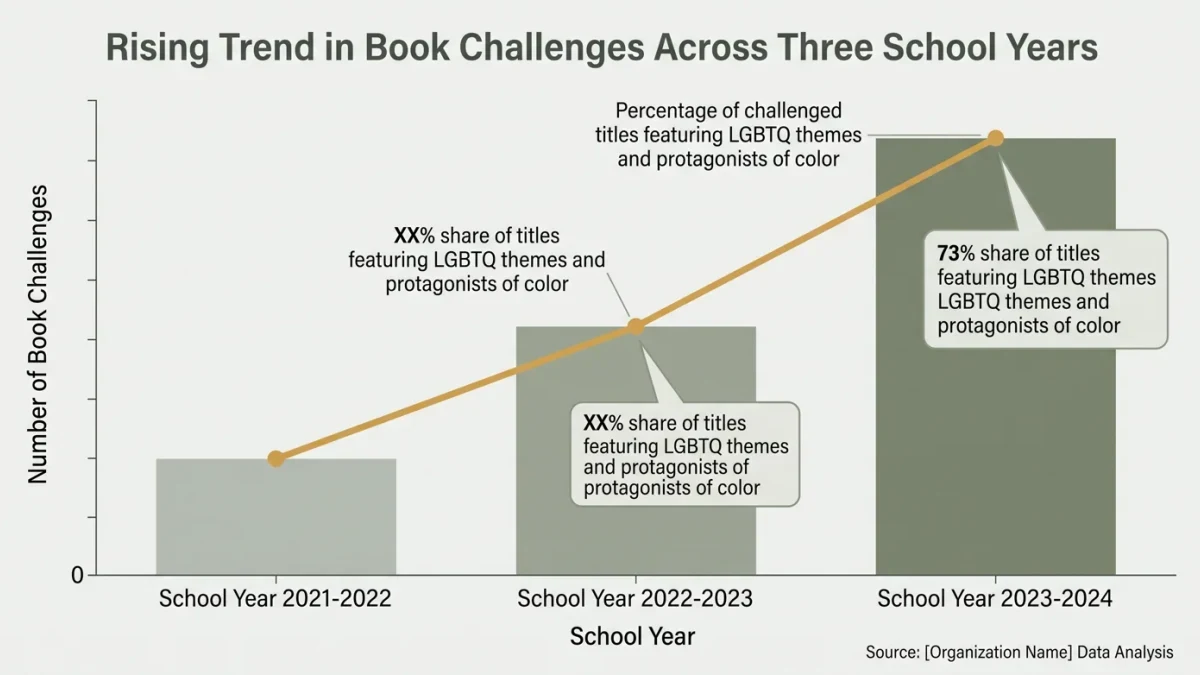
Attempts to remove books from school libraries and classrooms set records for a third consecutive year, per the American Library Association's accounting — over 10,000 removal attempts affecting more than 4,000 unique titles in the most recent tracked year, driven increasingly by organized campaigns filing duplicate challenges rather than individual parents. PEN America's separate school-book-ban index, which counts enacted removals rather than attempts, documented thousands of bans concentrated in a handful of states and disproportionately targeting books about race, racism, and LGBTQ characters. In January 2026, per Supreme Court filings, the justices heard argument in a case testing whether removing books in response to viewpoint objections violates students' First Amendment rights — the genre's clearest test since the 1980s.
What do the counts actually measure?
Two different things. The ALA counts challenges — formal requests for removal — reported voluntarily by libraries, so its figures are a floor. PEN America counts removals from specific districts, verified against policy records and reporting, using a definition that includes books pulled pending review. Both datasets agree on the pattern: the majority of banned or challenged titles feature protagonists of color or LGBTQ themes, and a large share of recent challenges originate with a small number of filers — Florida's school-book objection statistics, released under state law, showed a few dozen objectors accounting for thousands of challenges, many from outside the districts targeted.
What is the governing law?
Board of Education v. Pico (1982) held that students have a First Amendment right to receive ideas in school libraries, and that school boards may not remove books to suppress ideas they dislike — though the plurality's test left room for pedagogical judgment, and courts have applied it inconsistently for decades. Modern litigation splits on state legislation: laws requiring parental review, ratings systems for library content, and criminal exposure for librarians who provide harmful materials — the Texas and Iowa statutes being the leading examples — have drawn preliminary rulings in both directions. The case argued in January 2026, arising from an Iowa county's removal of LGBTQ-themed titles, presents the question Pico left open: whether removals triggered by officials' religious and viewpoint objections, without pedagogical process, are unconstitutional per se.
What does the advocacy record on both sides say?
Supporters of removal laws, organized under parental-rights banners, argue parents should control curriculum content and that schools' selections among thousands of titles are policy choices, not censorship — a position advanced in the litigation by state attorneys general and in model legislation circulated to legislatures. Opponents — the ALA, publishers' associations, civil-rights groups, and the authors and students who are the lawsuits' plaintiffs — answer with the operative fact of the current wave: the challenged books cluster by subject, which is viewpoint targeting under Pico, whatever the statutory wrapper. Both sides cite the same value, children's welfare; the contested terrain is who decides.
What are the practical effects in libraries?
Chilling effects documented by surveys and reporting: preemptive removals by librarians avoiding criminal exposure, blanket shelf reviews in districts with no challenge filed, and departures of library staff — a shortage the School Librarian investigation series and state association surveys have tracked. Publishers and authors have joined suits as plaintiffs, a new formation in the litigation. On the other side, some districts report the controversy raised engagement, with challenged titles in demand. The market effects are asymmetric: large publishers face pressure both ways, while small presses specializing in LGBTQ youth titles — the most-banned category — describe sales effects that compound the legal ones.
What should readers watch?
The decision in the argued case, expected by mid-2026, will set the constitutional baseline for removals nationally — and either validate the Pico framework for the modern wave or narrow it toward deference, in which case the state statutes become the operative rules. Meanwhile the ALA's count continues annually, and its shape is itself an answer: a removal pattern that tracks subject matter is the fact every branch of this dispute is now organized around.