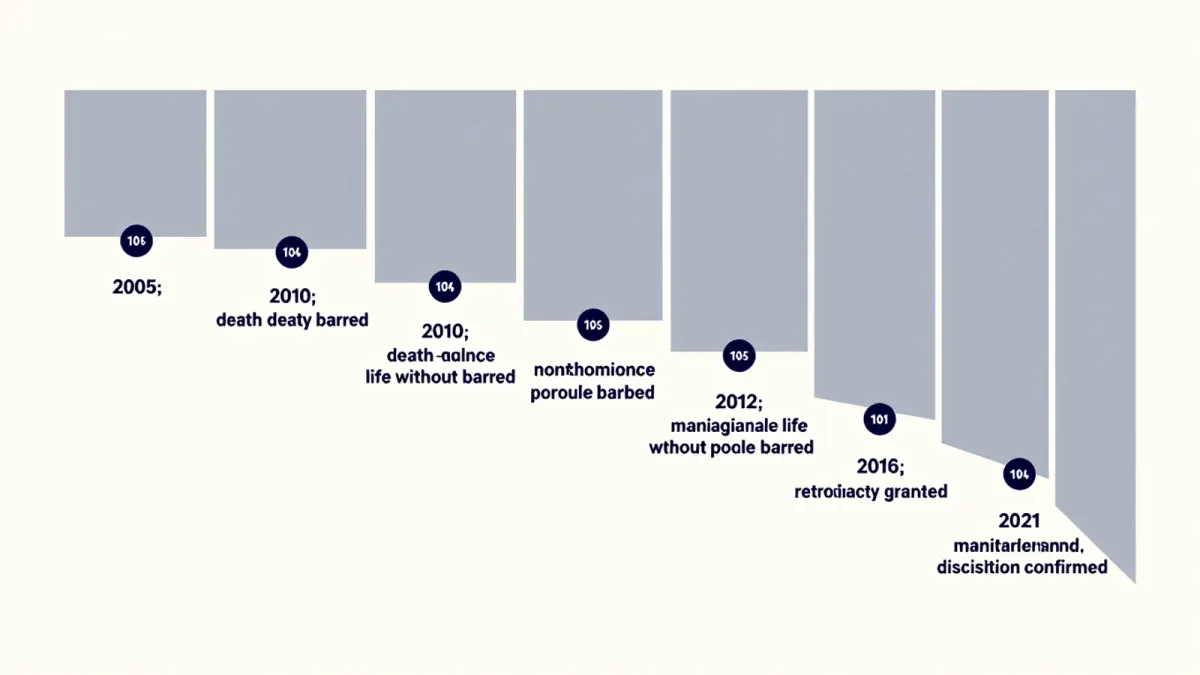
The Supreme Court has transformed juvenile life without parole over two decades: Roper v. Simmons (2005) ended the juvenile death penalty, Graham v. Florida (2010) barred life without parole for non-homicide crimes, and Miller v. Alabama (2012) struck mandatory life-without-parole sentences for children, requiring individualized hearings on youth and mitigation. Montgomery v. Louisiana (2016) made Miller retroactive. Yet per tracking by the Campaign for the Fair Sentencing of Youth and law-school data projects, over a thousand people remain imprisoned on sentences of life without parole imposed as minors, and roughly half the states still permit the sentence in some form, even as most have legislatively abolished it or never use it.
What does Miller actually require?
An individualized sentencing determination that accounts for what Justice Kagan's majority called children's diminished culpability and greater capacity for change: age, immaturity, family and home environment, the role of peers or coercion, and the possibility of rehabilitation. A formal hearing is not always required — the Supreme Court said in Jones v. Mississippi (2021) that a sentencer need not make a separate factual finding of permanent incorrigibility, over a dissent arguing the ruling hollowed Miller out. In practice, states differ on whether a full-blown Miller hearing precedes any JLWOP resentencing, and on what the prosecution must show: the sentence is supposed to be rare, reserved for the rare child whose crime reflects irretrievable depravity, but data collected by the Campaign for the Fair Sentencing of Youth shows new JLWOP sentences continue to be imposed in a shrinking set of states.
Who is serving these sentences?
The population is heavily concentrated by both geography and race. Phillips Black's project data and the CFSY's counts found a majority of the serving population came from a handful of states — Pennsylvania, Michigan, Louisiana, California, and Florida historically led — and nationally, Black children received JLWOP at rates far exceeding their share of cases. A large share of the population were sentenced as accomplices or under felony-murder theories, where the child did not kill anyone. The resentencing wave after Montgomery produced hundreds of new hearings, with results that studies summarized as mixed: substantial numbers received reduced terms, many with decades-long parole eligibility dates, while prosecutors in some counties re-sought life without parole, producing county-level variation that turned geography into the operative sentence.
What did states do legislatively?
More than half the states plus D.C. have now abolished JLWOP by statute for all children or narrowed it to homicide with specific findings, per the Sentencing Project's tracking. Some legislatures substituted lengthy term-of-years — including, controversially, sentences with minimums of 40 or 50 years, which advocates call life without parole by another name and courts have generally upheld against Miller challenges, since Miller's rule applies only to actual life sentences. A parallel reform line, mitigation-based review for all extreme youth sentences, has advanced in a few states under the banner of giving every child a meaningful chance of release, with model legislation promoted by the CFSY.
What about parole for people resentenced?
Resentencing to parole eligibility created its own bottleneck: parole boards, applying the same risk instruments and political caution described elsewhere in this system, have granted release to a minority of applicants in most states, and litigation in Pennsylvania, Michigan, and Louisiana contested whether a parole hearing that virtually never grants release satisfies Montgomery. Courts have split on how demanding that review must be — some requiring meaningful opportunity, documented reasons, and consideration of youth factors; others accepting existing board practice. The result is a two-stage test: the sentence becomes eligible, and then the board decides, and the second stage has proven more resistant to doctrine than the first.
What is the international picture?
The sentence is nearly unique to the United States. Human-rights bodies, including the U.N. Human Rights Committee reviewing U.S. compliance with the ICCPR, have repeatedly flagged JLWOP as a treaty concern, and research collected by Amnesty International documents no comparable populations of children serving life elsewhere. Domestically, the doctrine's trajectory has been one-directional — each ruling since Roper has narrowed the sentence — but Jones showed the Court's appetite for further consolidation is limited, leaving the remaining population's fate to statehouses and parole boards, where it sat before 2005.