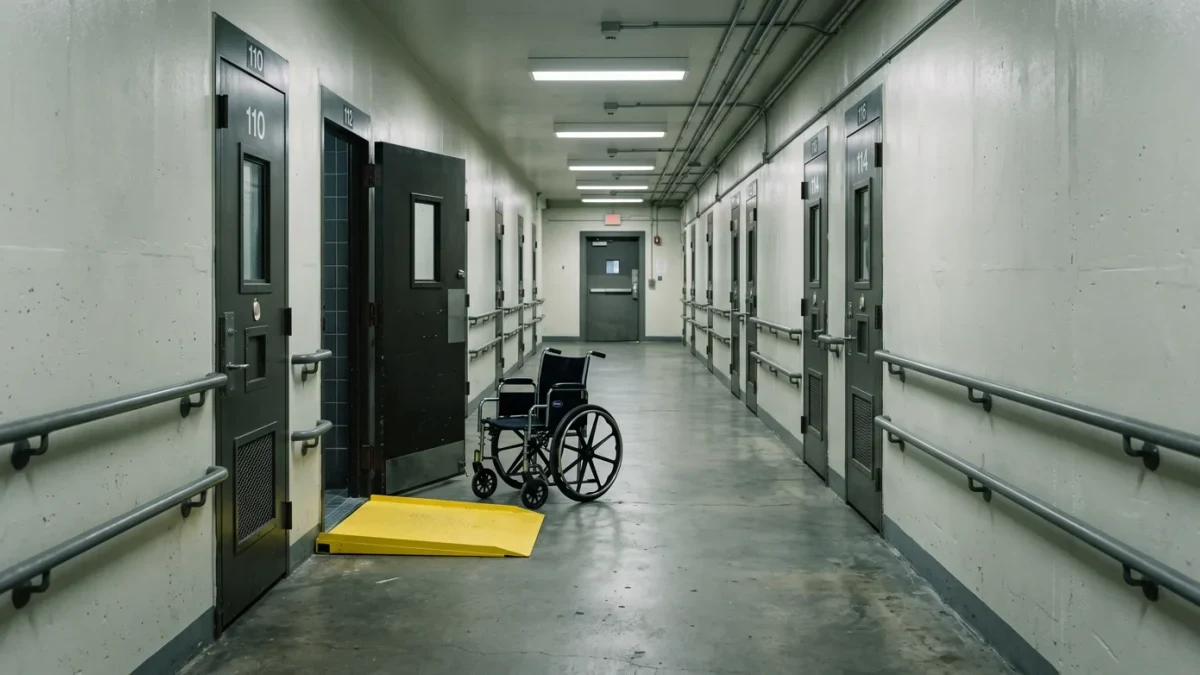
The Americans with Disabilities Act applies fully to jails and prisons: under the Supreme Court's decision in Pennsylvania Department of Corrections v. Yeskey (1998), state prisons are public entities obligated by Title II to provide reasonable accommodations to qualified people with disabilities, whether physical, psychiatric, sensory, or cognitive. In practice the obligation shows up in Justice Department settlements across the country — sign-language interpreters at disciplinary hearings, wheelchair-accessible cells and showers, continued psychiatric medication, and modified policies for people with intellectual disabilities — and in a steady stream of litigation over what institutions refused to provide.
What does Title II require inside a facility?
Title II's core command is meaningful access to services, programs, and activities. Inside a correctional facility that translates into several concrete duties: screening and identification of disabilities at intake; reasonable modifications to policies and rules when needed; auxiliary aids such as interpreters or accessible reading materials; accessible physical spaces, including cells, medical units, dining, and law libraries; and equal access to work assignments, education, and rehabilitation programs. Denial cannot be justified by convenience or expense alone — a public entity must show that a modification would fundamentally alter its program or impose an undue financial burden, a high bar in the settled cases.
Which populations drive most of the litigation?
Two groups dominate: people with hearing loss and people with psychiatric disabilities. Deaf people in custody have repeatedly won or settled cases over the absence of interpreters at classification, medical appointments, and disciplinary proceedings — the Justice Department's settlement with the Kentucky prison system in 2023, covering similar ground, remains a reference point for what compliance looks like. For psychiatric disability, the recurring disputes concern segregation: placing people with serious mental illness in solitary confinement has drawn ADA claims alongside Eighth Amendment arguments, on the theory that isolation is itself a harmful and unnecessary response to disability. suits under both theories have reshaped policies in several large systems.
How does the ADA interact with the Constitution?
The statutes overlap rather than replace each other. The Eighth Amendment bars deliberate indifference to serious medical needs; the ADA is broader in one direction and narrower in another — it does not require proving subjective culpability, but it demands only accommodations, not adequate care as such. A person can therefore lose a constitutional claim and win an ADA claim: the refusal to provide an interpreter, for instance, is rarely deliberate indifference to a medical need, but it is a textbook denial of meaningful access. Remedies differ as well, and under United States v. Georgia (2006), Congress validly abrogated state sovereign immunity for ADA conduct that also violates the Constitution.
What do compliance agreements look like?
Justice Department settlements and court decrees follow a recognizable template: systemic screening with validated instruments, staff training, assistive devices and interpreter services on a documented timetable, physical-plant modifications with deadlines, and monitoring by outside experts with public reporting. County jails, which hold most of the nation's incarcerated population on any given day, settle frequently because they are smaller systems with older facilities. The persistent gap identified in monitoring reports is not the paperwork but implementation — devices ordered and never distributed, interpreters scheduled for hearings but not for medical intake.
What can a person in custody or a family member do?
Complaints can go to the institution's ADA coordinator, which every covered public entity must designate, and to the Justice Department's Civil Rights Division, which accepts complaints about correctional facilities. The statute of limitations for private suits follows state law, typically two to three years. Family members often supply the documentation that institutions do not: prescription lists, audiograms, prior individualized education plans. Exhaustion of internal grievance procedures is generally required for constitutional claims under the Prison Litigation Reform Act, and courts have split on how ADA claims fit those rules — another reason early, written complaints matter, since they create the record any later process will read.