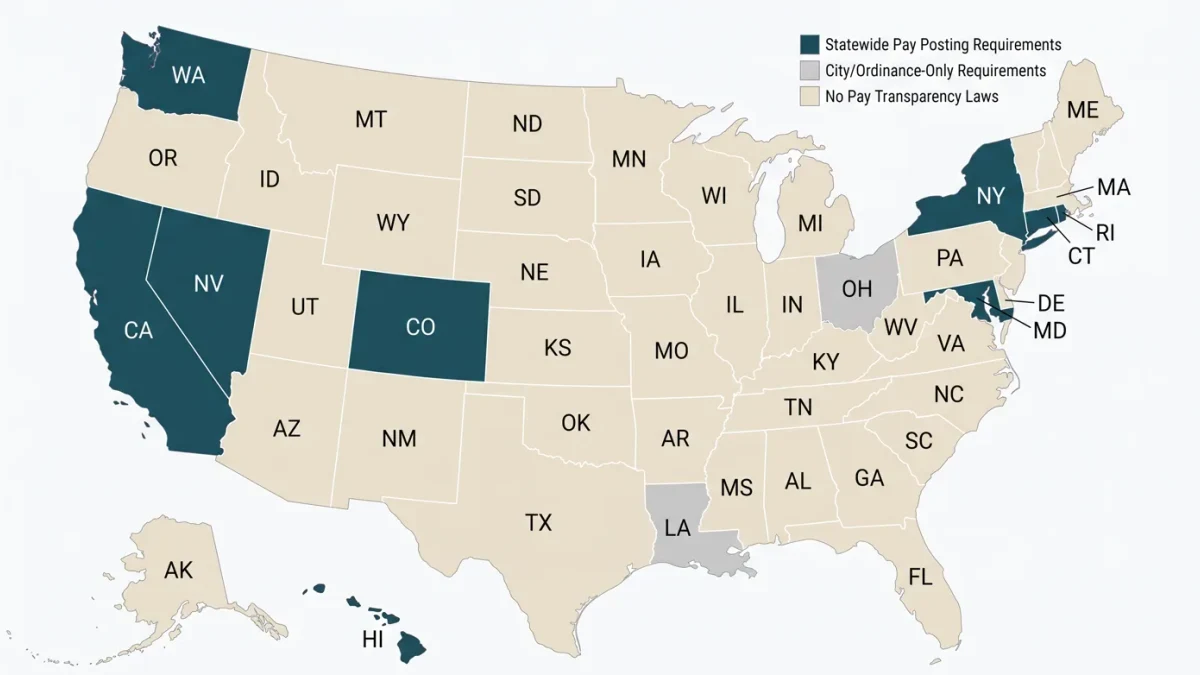
Roughly a third of American workers now live in a jurisdiction that requires employers to include pay ranges in job postings, a change assembled state by state since Colorado first acted in 2021. The laws share a design — disclosure at the point of hiring, when bargaining power is weakest — but differ in thresholds, coverage of remote positions, and remedies. Research on the early adopters, published in labor-economics journals through 2024, has measured both intended and side effects: narrower pay gaps within firms, alongside some evidence of strategic posting behavior by employers.
Which states and cities have the laws?
Statewide statutes include Colorado, California, New York, Washington, Illinois, Hawaii, Maryland, Vermont, New Jersey, and Massachusetts, with several more legislatures considering bills in recent sessions. City-level ordinances in New York City, Cincinnati, Toledo, Jersey City, and Ithaca cover employers above size thresholds even where states have not acted. The New Jersey and Massachusetts laws, passed in 2025 and phasing in afterward, marked the newest wave, and their effective dates cluster in 2025 and 2026, making compliance a live issue across the mid-Atlantic and New England right now.
| Jurisdiction (examples) | Posting requirement | Coverage notes |
|---|---|---|
| Colorado | Compensation range plus benefits in every posting | Pioneer statute (2021); covers most employers with any CO employee |
| California | Pay scale in postings; pay-data reporting for large employers | 15+ employees for postings |
| New York State | Range in advertisements for jobs performable in NY | 4+ employees; strong remote-work reach |
| Washington | Wage scale in all postings | Applies to employers with any WA employee |
What do employers actually have to disclose?
The core duty is a good-faith pay range — the minimum and maximum the employer reasonably expects to pay for the role — in the posting itself, not on request. Most statutes also require descriptions of benefits or other compensation in at least general terms. Enforcement guidance from state agencies has addressed the recurring questions: ranges must be genuinely considered, not absurdly wide; promotions and transfer opportunities must be posted internally where the statute so provides; and job descriptions cannot be split into fictional postings to duck thresholds. Violations carry administrative penalties that escalate with repetition, and several states allow workers to complain without fear of retaliation provisions written into the same statutes.
How do the laws treat remote jobs?
Remote coverage is the most litigated question. Colorado's original rule led some national employers to exclude Colorado applicants entirely until enforcement guidance clarified the practice was itself unlawful evasion; New York's law applies to any position that can or will be performed in New York, including fully remote ones. For a national posting, the practical compliance approach most firms have adopted is to publish either the full range or jurisdiction-specific ranges rather than fence off states. Agency guidance in Washington and California has converged on the same reading: the location of the worker, not the headquarters, controls.
What effects have researchers measured?
Studies of Colorado and California postings have found pay dispersion within the same role narrowing at firms after disclosure, and some evidence of compression — new hires' offers clustering at the bottom of disclosed ranges. Economists have also documented a rise in the width of posted ranges, consistent with employers hedging, and a modest increase in bargaining information available to workers, which is the statutes' stated purpose. Pay-gap reporting regimes in California and Illinois layer a second mechanism: large employers must file workforce pay data by race and sex, giving regulators and researchers aggregate visibility the postings alone do not provide.
What should workers watch for?
The laws give applicants and employees a documented hook: a posting is a written record of what the employer expected to pay. Workers comparing an offer against the posted range, or noticing a role reposted with a higher floor, can raise the discrepancy with the state labor agency, and retaliation for doing so is separately prohibited. The statutes do not cap or set pay, and they do not require employers to disclose individual employees' salaries — the obligations run to postings and reporting, with individual pay remaining private unless the worker chooses otherwise.