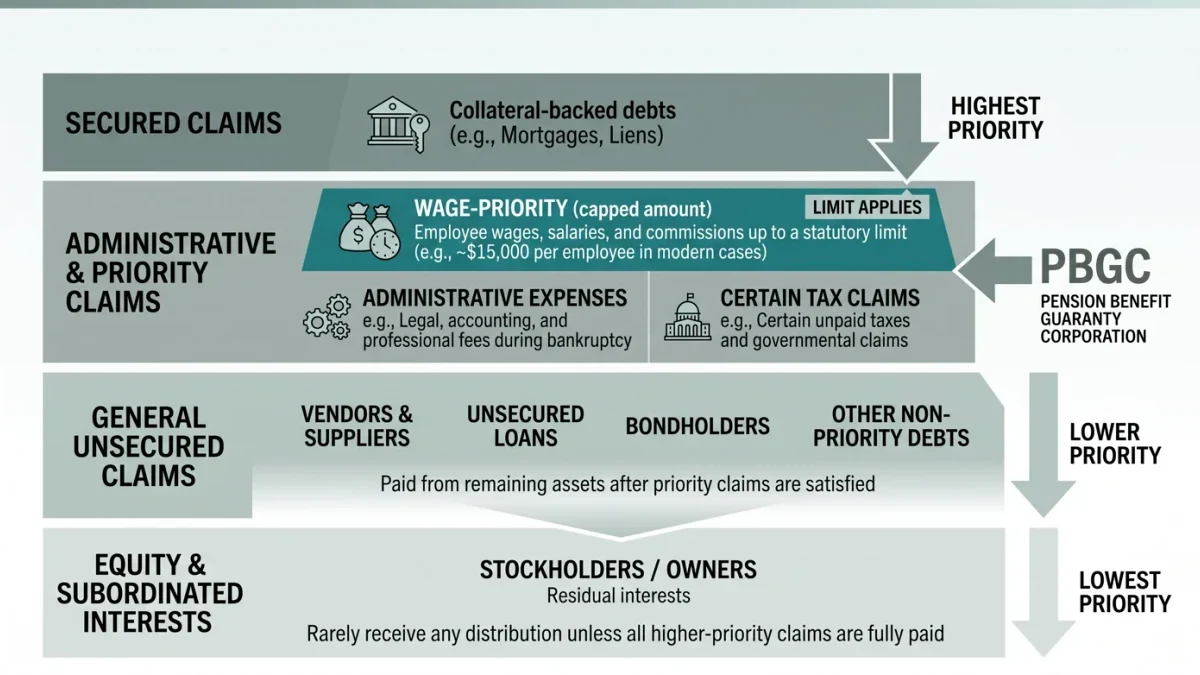
When an employer files Chapter 11, the wages owed, the accrued vacation, the severance promised, and the pension obligations all become claims against an estate with finite assets, and the Bankruptcy Code's priority ladder — not the employment contract — decides what workers receive. Wage claims up to a capped amount per worker get second-level priority ahead of general unsecured creditors; pension benefits are handled through a separate federal guarantee structure; and the claims from pending discrimination or wrongful-termination suits compete with everyone else's unless settled. The caps, which Congress set in 2005 and adjusts only by three-year inflation tripping, have not kept pace with wages in recent cycles, bankruptcy practitioners note. News Bay 71 publishes information, not legal advice.
What is the wage priority?
Section 507(a)(4) gives priority to wages, salaries, and commissions — including vacation, severance under some courts' readings, and benefits — earned within 180 days before the filing, capped per worker. Claims above the cap, or earned earlier, sink to general unsecured status, where recoveries are typically a fraction of the claim. The 180-day lookback produces its own harshness: long-tenured employees owed months of pay recover partially, while executives' deferred compensation sits in a subordinated tier that recovers last. Workers also face the mechanics of any mass-claim process: bar dates, proof-of-claim forms, and counsel who are busy with the financing fights that actually allocate value.
What about pensions?
Defined-benefit pensions are insured: the Pension Benefit Guaranty Corporation, a federal corporation funded by premiums, takes over failed plans and pays benefits up to legal maximums — maximums that bind early retirements hardest, per the PBGA's own benefit-support data on plan terminations in retail, airline, and steel bankruptcies. 401(k) contributions withheld from paychecks are trust funds, not estate assets, and must be turned over; the recurring failure mode is contributions withheld in the weeks before filing and spent on operations, which draws Department of Labor enforcement and, in documented cases, personal liability for responsible officers. Retiree health and life benefits have their own section — the.Retirees' committee structure under Section 1114, requiring negotiation before cutting benefits, with courts supervising.
What happens to litigation claims?
An employee suing for discrimination, harassment, or wrongful discharge holds a general unsecured claim — the estate may assume or reject the employment-related contracts, and pending suits continue against the estate's insurance where coverage exists, which is where most recoveries actually come from in employment cases. Bankruptcy also pauses wage-and-hour collective actions, including overtime claims under the FLSA, which resume as claims processes; the fast-food and retail wage-theft cases that ended in bankruptcy courts produced the fraction-on-the-dollar outcomes that motivated state wage-lien and bond statutes in several legislatures. WARN Act claims for plant-closing notice failures add another category, sometimes with penalty damages that bankruptcy judges can reduce as penalties rather than compensation.
What leverage do workers have?
More than their claim size suggests. The employees' committee — a statutory or court-appointed body in larger cases — negotiates over benefit plans and can object to settlements that short workers; unions with collective-bargaining agreements hold the special leverage of Section 1113, which bars rejecting a CBA without bargaining and court findings that employees shared the sacrifice fairly. Strikes are not barred by the automatic stay, a point labor lawyers emphasize, and the financing terms that debtor companies need — including the bankruptcy loans that fund operations — have increasingly included worker-protection provisions negotiated by pension funds and unions as creditors. The historical record includes the converse: retail and airline cases where pension terminations and benefit cuts proceeded over objections, with the PBGC absorbing pension losses that premium-payers, not the shareholders, funded.
What should workers do when an employer files?
File the proof of claim by the bar date; document hours, withheld contributions, and accrued benefits; check the PBGC's plan-search when a pension is involved; and treat the union or the employees' committee as the information channel. The estate's schedule of wages owed is often incomplete, and claims auditors compare payroll records, not memories — the worker with records recovers; the worker without waits for the trustee's diligence.