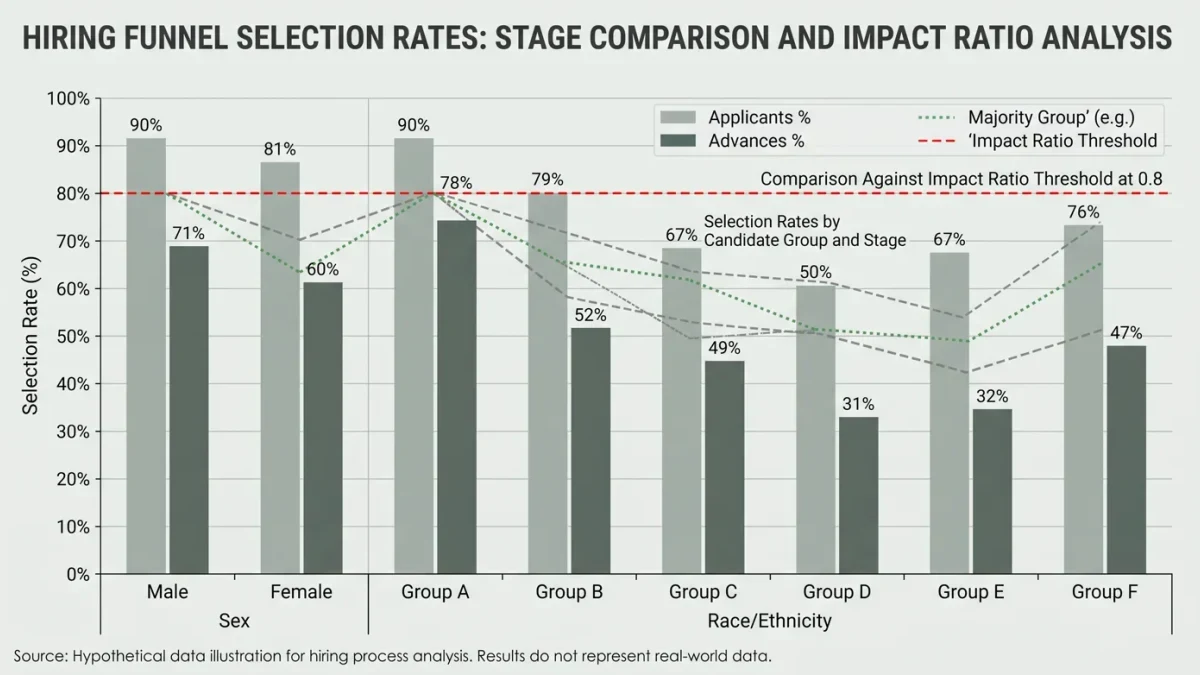
Employers using artificial intelligence to screen resumes, score video interviews, or rank candidates are subject to the same anti-discrimination statutes that govern human decision-makers — Title VII, the ADA, and the Age Discrimination in Employment Act — and a small but growing set of rules addresses the tools specifically. New York City's Local Law 144, in force since July 2023, forbids using automated employment decision tools in hiring or promotion unless the tool has been audited for bias annually, the results posted publicly, and candidates notified; Colorado's AI Act, adopted in 2024 and phased in from 2026, imposes a duty of reasonable care on deployers of high-risk AI systems including hiring tools, with impact assessments and notice requirements. Per the Equal Employment Opportunity Commission's enforcement guidance on AI and software testing, disparate impact — facially neutral tools producing racial, sex, or age disparities — is the theory the agencies are applying.
Why do hiring algorithms discriminate?
Because they learn from history. A ranking model trained on a company's past hires learns whatever patterns those hires encoded — that successful engineers looked a certain way, went to certain schools, or bore names of a certain origin — and reproduces the pattern at scale. The documented cases made the mechanism famous: Amazon's experimental recruiting tool, reported by Reuters in 2018, learned to downgrade resumes containing the word women's; the Justice Department and EEOC's settlements have challenged companies using personality and cognitive screens; and the EEOC's 2023 guidance on the ADA addressed the now-standard failure modes — screens that discount applicants with gaps and accommodations, and video-interview tools scoring speech patterns and facial expressions in ways correlated with disability and race.
What does the NYC audit actually require?
A bias audit by an independent auditor calculating the tool's selection-rate disparities by sex, race-ethnicity categories, and intersectional bands, published on the employer's website with the distribution date and other statutory disclosures — plus candidate notice at least ten business days before the tool is used, with an option to request an alternative process. The rule's first years produced a compliance pattern critics have documented: audits that calculate rates without publishing underlying data, auditor independence loosely defined, and enforcement limited to fines per violation per day, with the number of citations issued by the city's civil rights commission remaining small. The Colorado act's framework — deployer duty of care, annual impact assessments, adversarial testing, and a statutory defense for compliant deployers — is the broader model other legislatures have copied since.
What is the vendors' exposure?
Structured as toolmakers rather than employers, vendors historically escaped statutory coverage, since Title VII applies to employers and agencies. That boundary is moving: plaintiffs have sued toolmakers directly under the ADA in the Mobley v. Workday litigation, which the federal court in California allowed to proceed as an agent theory in 2024 — the first ruling treating a screening vendor as potentially liable as an agent of the employer. The case's class allegations over racially discriminatory scoring are the template the plaintiffs' bar has watched, and vendor contracts now allocate audit and liability duties explicitly as a result.
What does compliance look like now?
The practice that has consolidated across large employers: pre-deployment disparate-impact testing on selection rates; annual re-validation of tools against job-relatedness, the standard the Uniform Guidelines on Employee Selection Procedures set for tests decades ago; human review of adverse decisions rather than rubber-stamp approvals, since the Chicago-style ordinance wave also regulates AI in working conditions; documented accommodations pathways; and retention of the data that any regulator or plaintiff will request. The twist compliance teams flag: retaining scoring data creates the discovery record for future claims, while deleting it looks like willfulness — the ordinary modern data-governance dilemma, arriving in employment law.
What should candidates know?
The rights that exist are notice-based: NYC candidates are entitled to advance notice of automated tools and can request alternative processes or accommodations; ADA applicants everywhere can request accommodation in application procedures, algorithmic or not. The unresolved frontier — algorithmic explainability in litigation, meaning whether a defendant must produce how the model scored a plaintiff — is being fought case by case, and its outcome will determine whether these tools are as challengeable as the humans they replaced.