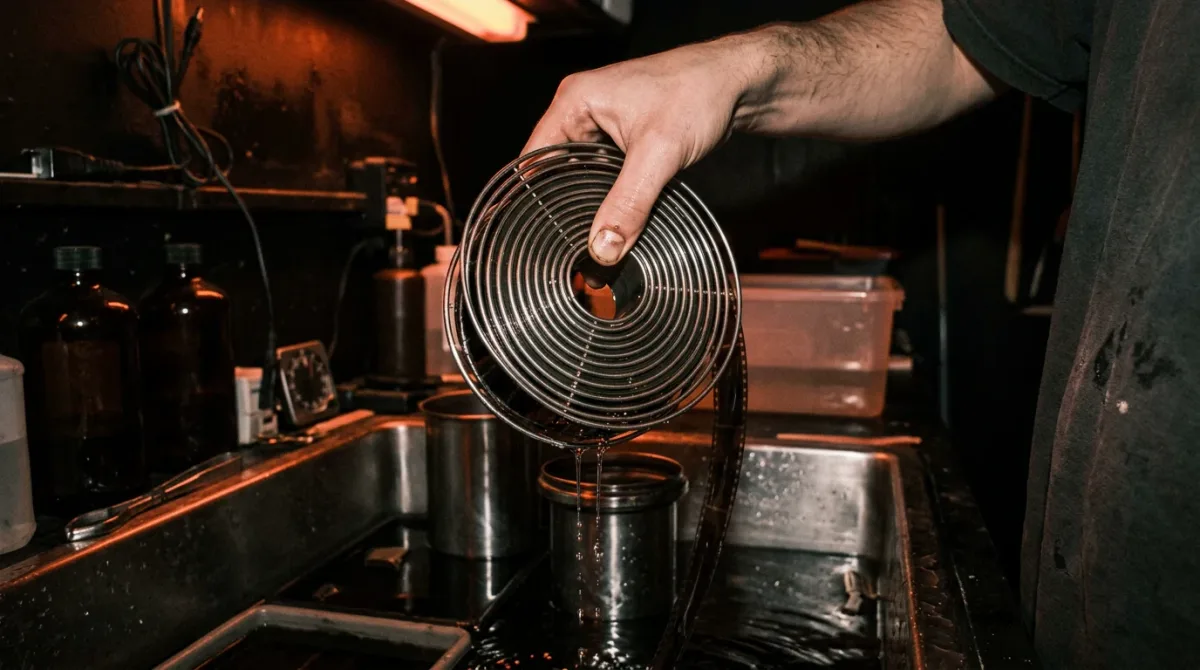
Every home-processed roll ends the same way: fix, then wash, then hang to dry. It's the step most people rush, because water doesn't smell like chemistry and nothing visibly happens. But an underwashed negative doesn't fail today — it fails in ten or twenty years, as a faint stain creeping into the highlights. The wash step exists to prevent exactly that.
How long should you wash black-and-white film after fixing?
For running water in a small tank, Kodak's black-and-white processing guidance calls for a wash fast enough to fully replace the water in the tank at least once every 5 minutes, per its published processing chart (SRC-02). Ilford's own spiral-tank method skips running water entirely, using a fixed sequence of water changes and inversions instead (SRC-01). Both approaches are designed to reach the same endpoint: clearing residual fixer from the emulsion, and both assume you're starting the wash clock only after the fixing step is fully complete — a partially fixed negative will not wash clean no matter how long you run water over it.
These numbers are minimums for a well-agitated tank at typical room temperature, not hard universal constants. Colder water slows the diffusion of thiosulfate out of the gelatin emulsion, so a wash carried out at a low tap temperature may need to run longer than the stated times to reach the same result. Neither manufacturer publishes a simple temperature-adjusted table for this, so the safest practice is to keep wash water close to your processing temperature rather than trying to compensate with extra minutes alone.
Why does wash time actually matter for a negative's lifespan?
Fixer works by dissolving unexposed silver halides into soluble thiosulfate compounds, but some of that thiosulfate stays trapped in the emulsion afterward. Left in place, it keeps reacting with the image's silver over years, slowly converting it to silver sulfide — the mechanism behind the yellow-brown staining seen on old, poorly washed prints and negatives. Federal materials research measured this directly: a sample carrying just 0.07 mg of residual sodium thiosulfate per square inch showed a 111 percent increase in silver sulfide formation compared to a properly washed sample, and the reaction runs slowly at low relative humidity but noticeably faster at high relative humidity (SRC-03). The wash step isn't cosmetic — it's the only thing standing between a fresh negative and that slow chemical decay. A negative can look perfectly clean straight off the reel and still be carrying enough thiosulfate to stain years later, which is exactly why wash procedures are specified as fixed times and cycle counts rather than left to visual judgment.
This is also why the fixing step upstream of washing matters as much as the wash itself. A negative fixed for too short a time, or in exhausted fixer, can leave more undissolved silver halide and thiosulfate byproduct behind than a properly fixed one — meaning it needs a more thorough wash to reach the same level of clearance, not less.
How do you wash film in a spiral tank without a running-water hookup?
Ilford's own spiral-tank method replaces a running-water rinse with a fixed number of water changes and tank inversions, useful for anyone processing at a sink without a hose adapter, or anyone trying to cut down on the amount of water a session uses (SRC-01):
- Fill the developing tank with water within about 5°C (9°F) of your processing solution temperature, load the reel, and invert the tank 5 times, then drain completely.
- Refill with fresh water and invert 10 times, then drain completely.
- Refill a third time and invert 20 times, then drain completely.
- For the final rinse, add a few drops of a wetting agent diluted around 1:200 to reduce water spots as the film dries.
If you're washing under a tap instead, Kodak's chart calls for water moving fast enough to fully exchange the tank's volume within 5 minutes, sustained for the full wash time rather than a quick rinse-and-drain (SRC-02).
Should you use a hypo clearing agent before washing?
A washing aid, sold as hypo clearing agent, is a chemical bath used between the fixer and the final water wash. Kodak's own procedure places it right after fixing: 1 to 2 minutes with continuous agitation for the first 30 seconds, then agitation every 30 seconds after that, followed by the standard water wash (SRC-02). Its job is to convert residual thiosulfate into compounds that rinse out faster, shortening the total wash time needed and giving a wider margin of safety if your water wash is imperfect.
A washing aid step is optional for film in Kodak's own procedure — the water wash alone is treated as sufficient when it's run for the full stated time — but it becomes more valuable in exactly the situations where washing is hardest to do well: cold tap water, low water pressure, or a home setup without a hose fitting for the reel-loading cap. In those cases, the pretreatment bath does some of the clearing work that a slow or inconsistent water wash might not finish on its own.
Common mistakes that undermine an otherwise good wash
- Treating "a couple of minutes under the tap" as equivalent to a timed wash. Without checking that the tank's water is actually being fully replaced, a casual rinse can leave thiosulfate behind even after several minutes.
- Skipping the final wetting-agent rinse. It doesn't remove fixer, but the water spots it prevents can be mistaken for washing residue and lead to unnecessary rewashing or scrubbing that risks scratching the emulsion.
- Ignoring temperature swings between baths. Ilford's method specifies wash water within roughly 5°C of the processing temperature; a cold-water shock can cause reticulation, the same cracked-emulsion texture that ruins fine grain.
- Storing a "probably clean" negative right away. Because thiosulfate damage is a slow reaction that speeds up in humidity, a marginally underwashed roll can look perfect at drying and still degrade in a humid closet years later, per the residual-thiosulfate research cited above (SRC-03).
FAQ
Does a hypo clearing agent replace the water wash? No. Kodak's procedure uses it as a pretreatment before the standard water wash, not a substitute for it (SRC-02).
Is longer washing always better? Beyond fully clearing thiosulfate, extended soaking mainly risks softening the emulsion and encouraging water marks; neither source reviewed here recommends washing longer than their stated procedures.
Why does humidity matter for negatives that are already dry and stored? The thiosulfate-silver reaction that causes staining runs slowly in dry conditions and much faster in humid ones, so storage environment affects how much a marginal wash matters over time (SRC-03).
For a related film perspective, read How to Push Tri-X Two Stops Without Ruining It — Film.
For more context, read How to Choose a Guitar Humidifier: Specs, Prices, Trade-Offs.
For more context, read war.
For more context, read furiosa.