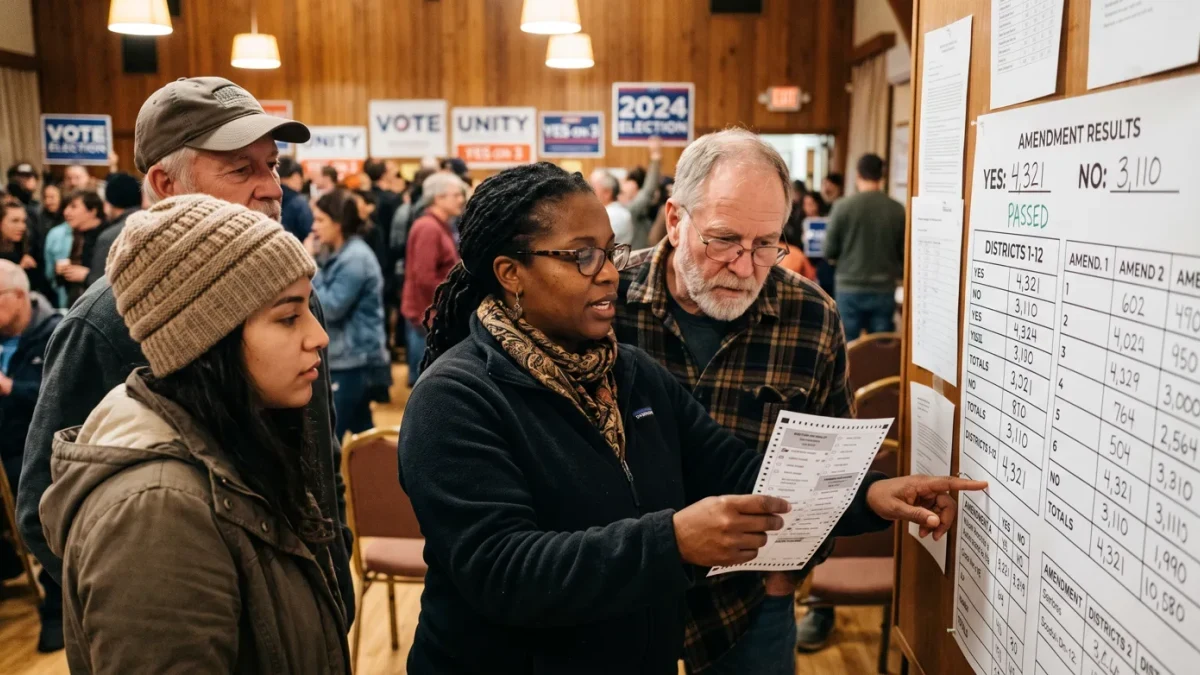
In November 2024, voters in Alabama, Oregon, Tennessee, and Vermont approved amendments removing slavery and involuntary-servitude exceptions from their state constitutions — clauses that dated to the nineteenth century and permitted forced labor as punishment for crime. The measures passed by wide margins, continuing a streak that began with Colorado in 2018 and Utah and Nebraska in 2020, and that later included Alabama's neighboring southern states. Advocacy coalitions that drafted the amendments, organized under the Abolition Amendment umbrella and state-level coalitions of faith and civil-rights groups, described the goal as both symbolic and practical: removing language that courts and departments read as constitutional cover for unpaid or compulsory prison labor.
What did these clauses actually say?
Most were Reconstruction-era texts copied from the Thirteenth Amendment itself, which bars slavery and involuntary servitude except as a punishment for crime. State versions varied: Vermont's 1777-era constitution was the oldest; Oregon's clause, added at its founding, was explicitly racial in origin until 2024's Amendment removed the exception; Alabama's 1901 constitution — the Jim Crow document — carried its exception among provisions courts had long cited as racially motivated in design. The campaigns made the drafting lineage part of the argument: these were not dormant phrases but texts with authors and intentions, and states were choosing whether to keep them.
Does removing the exception change prison labor immediately?
Not automatically, and the honest analysis separates three layers. First, the federal Thirteenth Amendment's punishment exception still governs federal constitutional law, so state constitutional text is a floor, not a ceiling, on what forced prison labor the U.S. Constitution tolerates. Second, within a state, removing the exception gives incarcerated workers a state-constitutional argument against punitive labor practices — refusal-to-work discipline, unpaid compulsory labor — that did not exist before. Third, what changes in practice depends on statutes, department policy, and litigation: Tennessee's and Oregon's amendments included language about how the change should be implemented, and departments in all four states stated after the vote that prison work programs would continue under existing rules.
What does prison labor look like now?
Per the Bureau of Justice Statistics' census of prison industries and academic studies of correctional labor, most people confined in state prisons work — in kitchen, laundry, maintenance, and facility support roles — with typical wages measured in cents per hour and, in several southern states, at zero. A smaller industry tier produces goods and services under state-use systems or, controversially, for private purchasers. The economic structure is why the stakes exceed language: a 2022 report by the University of Chicago Law School's Global Human Rights Clinic and the advocacy coalition Worth Rises, surveying prison labor across states, valued incarcerated workers' output in the billions while documenting average wages that leave deductions for restitution and fees consuming most pay. Extremes documented in the report included assignments under armed supervision outside prisons, including agricultural work in the Gulf South that researchers tied directly to the exception clauses.
What litigation and legislation followed?
Lawmakers in the amended states introduced implementation bills after 2024 — wage floors for prison assignments, limits on discipline for refusal to work, and transparency requirements for prison industries — and civil-rights attorneys flagged the new state clauses as vehicles for challenges to specific practices. The movement's national map is now nearly two dozen states reformed, with campaigns continuing in the holdouts. Federal proposals to amend the Thirteenth Amendment itself have been reintroduced in successive Congresses without advancing to a vote.
What should readers watch?
The indicator that matters is enforcement: whether courts in the four states treat the amendments as a real constraint on compulsory labor, whether departments change work-discipline rules, and whether wages move. Language amendments are the beginning of a litigation and policy pipeline that historically takes years to produce visible change. The vote's clearest immediate effect is expressive — eight figure margins of voters in politically different states agreeing the exception had no place in a founding document — but the practice the language permitted is measured in hours worked and dollars paid, and those numbers are public.